
Home Office Small Space Ideas That Actually Work
Working from a cramped apartment or a shared room is a real challenge. A dedicated room is a luxury most remote workers don’t have. But a productive home office setup is still possible in tight quarters.
The key is choosing furniture and systems that serve double duty. Space-saving desks, vertical storage, and smart cable management can transform even the smallest corner into a functional workspace. Here’s what actually works.
Choose a Desk That Disappears When You’re Done
The biggest space drain in any small workspace is a permanent desk. A standard desk occupies 20 to 30 square feet of floor space, whether you’re working or not. A foldable electric standing desk solves this directly.
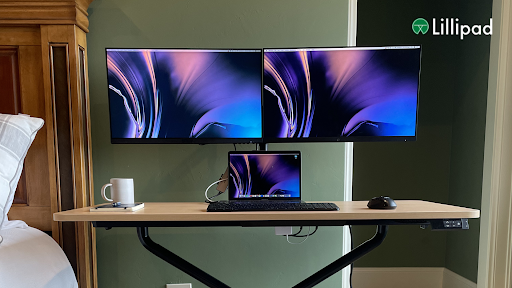
The Lillipad foldable electric standing desk collapses to just 6 inches tall. That means it slides under a bed or into a closet when the workday ends. You reclaim your living space without dismantling anything. No tools, no assembly, no dedicated room required. One customer in a studio apartment noted it fits under a twin bed with room to spare.
Use Vertical Space Instead of Floor Space
Floor space is scarce. Wall space usually isn’t. Shifting storage upward is the fastest way to open a room without moving walls.
Try these vertical storage approaches:
- Mount floating shelves 12 to 18 inches above the desk surface
- Use a monitor arm instead of a stand to free up the full desk surface
- Stack paper trays vertically rather than spreading them side by side
- Hang a pegboard for headphones, cables, and stationery
- Choose a tall, narrow bookshelf over a wide, low credenza
A single monitor arm can reclaim up to 40% of usable desk surface. Keep the floor zone under the desk completely clear so the space reads as open even during work hours.
Control Cables Before They Control You
Cable clutter makes a small space feel smaller. Exposed cords create visual noise that reduces the sense of order in compact rooms, a pattern documented in environmental psychology research from the University of Minnesota.
Run power through a built-in power strip when possible. The Lillipad desk integrates a power strip directly into the frame, removing the need for floor-level extension cords. Use these methods to keep cables managed:
- Route cords along the desk edge with adhesive cable clips
- Use a cable tray mounted under the desk surface
- Label each cable so disconnecting is fast when the desk folds away
- Bind loose cords with velcro ties, not zip ties, for easy adjustments
A clean cable system means your home office setup packs away in under a minute.
Pick Dual-Purpose Furniture Around Your Desk
Every piece of furniture in a small space should serve at least two functions. A storage ottoman doubles as seating and file storage. A bookshelf acts as both a room divider and a workspace boundary.
Good dual-purpose furniture choices for small offices include:
- A storage bench that holds files and acts as a window seat
- A narrow console table that works as a standing desk surface and entryway furniture
- A wall-mounted fold-down desk for the smallest rooms
- A backless stool that tucks completely under the desk when not in use
Avoid chairs with wide armrests if space is tight. When the desk folds flat, dual-purpose pieces shift back to their non-office role without rearranging the room.
Light the Work Zone Without Fixtures
Overhead lighting flattens a room and does little for task focus. A directed desk lamp defines the work zone without affecting the rest of the living space.
Use a clamp-style LED lamp that attaches to the desk edge. This avoids using floor or table lamps that consume surface or floor real estate. Key lighting specs for a small home office:
- 4,000K to 5,000K color temperature for alertness during work hours
- At least 400 lumens for screen-adjacent reading tasks
- A dimmable switch so the light can wind down in the late afternoon
- A lamp with a USB charging port built in to reduce plug count
OSHA’s Computer Workstations eTool specifies that supplemental task lighting should illuminate reading and writing surfaces while limiting brightness around monitors, with office lighting ranging between 20 to 50 foot-candles. When the task light goes off, the workspace visually disappears into the room.
Store Accessories In the Desk, Not Around It
Accessories left out between sessions consume space and make a small area feel disorganized. The solution is a system that brings everything to one point and keeps it there.
The Lillipad accessories collection includes items designed to integrate directly with the desk frame, such as monitor arms and laptop stands that attach to the structure itself. When the desk folds, most accessories fold or detach in seconds. Accessories that don’t attach to the desk should follow a strict storage rule:
- One small drawer unit or desktop organizer only
- No loose items left on the desk surface overnight
- Cables coiled and stored in a labeled pouch when not in use
- Headphones hung on a hook attached to the desk frame
This system keeps the room functional as living space when the home office setup is off the clock.
Define the Workspace With a Rug
In an open-plan apartment or studio, a rug creates a visual boundary between work and living zones. Stanford’s Human-Computer Interaction Group has published research on context and cognitive switching, noting that physical boundaries support mental transitions between tasks.
Choose a rug sized to fit only under the desk footprint. A 4×6 foot rug works for most compact setups. Practical rug considerations for a small home office:
- Low-pile rugs allow wheeled desk chairs and rolling desks to move freely
- A neutral color keeps the zone from competing visually with the rest of the room
- A non-slip backing prevents shifting on hard floors
- When the desk folds and rolls away, the rug remains as a neutral floor zone
The boundary effect works even in a single room. Your brain registers the rug as the “work zone” and the rest of the floor as living space.
Keep the Wall Behind Your Desk Minimal
A cluttered wall behind the desk adds visual weight to an already compact space. One focal element is enough. More than that competes with the room and shrinks how large the space feels.
Effective single-wall treatments for a small home office:
- A whiteboard for notes and weekly planning
- A pegboard with hooks for tools, cables, and headphones
- One framed print at eye level for a visual anchor
- A small wall-mounted shelf for a plant and one decorative item
Stick to one treatment per wall section. Clean walls make small rooms read larger, which directly supports focus during long work sessions. A home office setup in a small space works best when the surrounding environment stays intentionally simple.

