

What Greater Phoenix Homeowners Are Getting Wrong About Luxury Closet Organization
Luxury closet organization is often misunderstood because many homeowners still treat it as a storage problem rather than a lifestyle system. In higher-end homes, that distinction matters. A closet can have generous square footage, custom shelving, and premium finishes, yet still fail to function well in daily life. Across Greater Phoenix, more homeowners are realizing that a beautiful closet is not necessarily an effective one. The real standard is not whether the space can hold more. It is whether the space supports visibility, accessibility, editing, and routine without creating friction. That is where many otherwise well-designed closets still fall short.
More Storage Does Not Automatically Mean Better Organization
One of the most common mistakes homeowners make is assuming that organization begins and ends with adding more storage elements. More shelves, more bins, more rods, and more compartments can help in certain cases, but they do not solve the larger issue if the system itself is not built around actual use. A closet can become more crowded rather than more functional when additional storage is layered onto an already unclear setup. Capacity, by itself, rarely creates clarity.
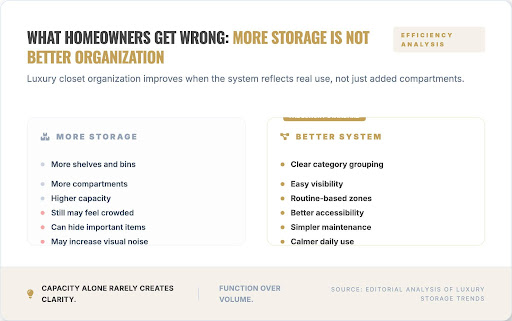
In luxury homes, this mistake becomes easier to overlook because the closet may already look impressive. The finishes may be beautiful. The dimensions may be generous. The lighting may feel elevated. Yet if the wardrobe is difficult to scan, categories are not intuitive, or important items keep disappearing into secondary zones, the space is not really organized. It is simply full. That is why luxury closet organization has to be judged by function as much as appearance.
Luxury Organization Is Really About System Quality
The stronger way to think about closet organization is in terms of system quality. A good system makes it easier to see what is owned, access frequently used items, and maintain order over time. It reduces the number of daily decisions that require extra effort. It also supports natural habits instead of fighting them. When a closet system is poorly aligned with how someone actually dresses, stores, edits, and rotates clothing, even a high-end space can quickly become inefficient.
This is one reason luxury homeowners are placing more importance on an organization that feels tailored rather than generic. They want wardrobes grouped in ways that match real routines. They want the space to make visual sense at a glance. They want the closet to remain composed after daily use, not only after a reset. That level of organization is less about containing items and more about creating a structure that continues to work under normal life conditions.
Greater Phoenix Homeowners Are Starting to Reframe the Issue
A recent Greater Phoenix-focused article, “Why Luxury Home Organization Is Becoming a Bigger Priority Across Greater Phoenix,” argued that affluent homeowners are increasingly treating closet organization as part of the overall living experience rather than an isolated storage concern. That local framing is useful because it captures the mindset shift now taking place in many higher-end homes. The conversation is moving away from simple decluttering and toward a more refined question. How should the closet support the rhythm, presentation, and ease of the home itself?
That shift is especially relevant in Greater Phoenix, where luxury homes often blend visual polish with highly active lifestyles. Homeowners may need closets that support business attire, event wear, seasonal rotation, resort clothing, travel preparation, and a broad range of accessories. In that environment, the closet needs to do more than accommodate volume. It needs to create order that remains legible and usable even as routines change throughout the week or season.
Visibility Matters More Than Many Homeowners Realize
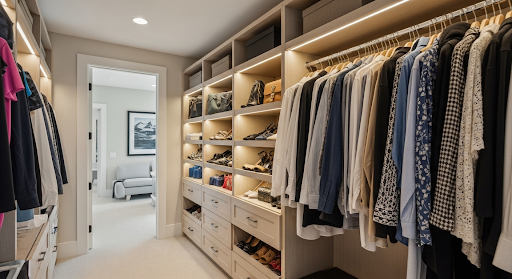
Another common mistake is underestimating the importance of visibility. Many people think of organization as putting things away neatly, but the stronger approach often makes important categories easier to see rather than simply more hidden. In a luxury closet, visibility is one of the keys to reducing friction. It helps prevent unnecessary duplication, makes outfit planning easier, and allows the homeowner to make better decisions about what belongs in the space long term.
When visibility is poor, the closet becomes harder to manage, regardless of how expensive the built-ins are. Items get forgotten. Daily choices take longer. Maintenance becomes more reactive than intentional. Over time, that makes the closet feel heavier and less controlled than it should. A well-organized system gives visibility a structural role. It helps the wardrobe stay readable, which is one of the clearest signs that the space is actually working.
Editing Is Part of Luxury, Not a Threat to It
Many homeowners also make the mistake of treating editing as a loss rather than as part of refinement. In reality, a luxury organization often depends on strong editing. That does not necessarily mean owning less in absolute terms. It means deciding more clearly what deserves premium visibility, what should rotate seasonally, what belongs elsewhere, and what no longer supports the way the wardrobe is actually used. A closet that tries to hold everything with equal emphasis usually loses coherence.
Editing matters because luxury is increasingly defined by ease and control. A closet that preserves that feeling has enough space around important categories to remain usable and visually calm. When the wardrobe is too dense, the space starts to create visual and operational noise. The better approach is selective visibility supported by intentional rotation. That tends to create a much stronger experience than simple accumulation.
Accessibility Is What Turns a Closet Into a Daily-Use Space
Another misconception is that organization is mostly visual. In practice, accessibility is just as important. A closet can look composed and still be frustrating if commonly used items are inconvenient to reach, if zones are poorly arranged, or if category placement does not reflect how the homeowner moves through the space. A luxury organization depends on reducing those small points of friction. The goal is not only to make the closet look ordered. It is to make the routine feel easier.
That is one reason the best closet systems often feel almost invisible in use. They support the homeowner without demanding extra thought. Shoes are where they should be. Key wardrobe categories are easy to scan. Accessories are not buried. Travel-related pieces can be gathered quickly. Seasonal items rotate without disrupting the core layout. When those conditions are in place, the closet starts to feel like part of a well-functioning home rather than a beautiful but demanding container.
Luxury Closet Organization Should Reflect Real Life
One of the deeper errors homeowners make is organizing for an idealized version of life rather than for actual behavior. A closet may be arranged around abstract categories or visual symmetry while ignoring how the owner truly dresses and moves. That can produce a space that photographs well but performs poorly. In luxury homes, the better standard is not perfection for display. It is a system that remains elegant while still matching the patterns of real use.
A local example of this more practical and elevated approach can be seen in this Scottsdale closet organization service overview, which reflects the idea that closet organization should support clarity, accessibility, and daily ease rather than create a tidier appearance. That distinction matters because the strongest luxury spaces are not merely attractive. They are deeply usable.
Cheryl Frager and Lila Tippit See the Difference Between Storage and Strategy
Cheryl Frager and Lila Tippit, co-owners and operators of Make a Smooth Move, say one of the biggest differences they see in luxury closet projects is whether the homeowner is thinking in terms of storage volume or lifestyle function. The more successful outcomes usually come from the second perspective. Clients tend to benefit most when they focus on what needs to stay visible, how the space should support daily routines, and what kinds of edits will help the system last rather than collapse back into disorder.
That insight reflects a broader truth about high-end organizations. Luxury does not come from having more compartments alone. It comes from creating a system with enough intelligence and restraint to keep the space calm, useful, and durable. In other words, the strongest closet organization is strategic before it is decorative.
Conclusion
What Greater Phoenix homeowners are getting wrong about luxury closet organization is the assumption that more storage automatically yields better results. In reality, the strongest luxury closets depend on system quality, not just storage volume. They rely on visibility, editing, accessibility, and a layout built around real routine. As higher-end homeowners continue to expect more from daily-use spaces, the closet will increasingly be judged not by how much it can hold, but by how effortlessly it helps the home function. That is the difference between a full closet and a truly organized one.

