

What South Louisiana Contractors Can Learn From Better Containerized Jobsite Storage
On many construction sites, storage decisions are made reactively. Materials arrive, tools need a place to go, and crews create whatever order they can from the space available. That approach is common, but it often leaves job sites with more friction than necessary. Across South Louisiana, contractors are learning that better containerized jobsite storage is not just about having a place to put things. It is about building more control into the site itself. When storage becomes more deliberate, the job tends to become easier to manage. Materials stay protected, crews lose less time, and the site operates with more consistency from day to day.
Storage Works Best When It Is Treated as Part of the Job
One of the clearest lessons contractors can take from better containerized storage is that storage should not be treated as an afterthought. On an active site, storage affects more than security. It affects access, movement, staging, and the efficiency with which crews can work around each other. When materials and tools are loosely distributed across a site, the project begins to absorb inefficiency in small but repeated ways. Workers spend extra time retrieving what they need. Inventory becomes harder to track. Deliveries create congestion rather than moving the job forward. These are not always dramatic failures, but they are exactly the kinds of operational losses that add up over the life of a project.
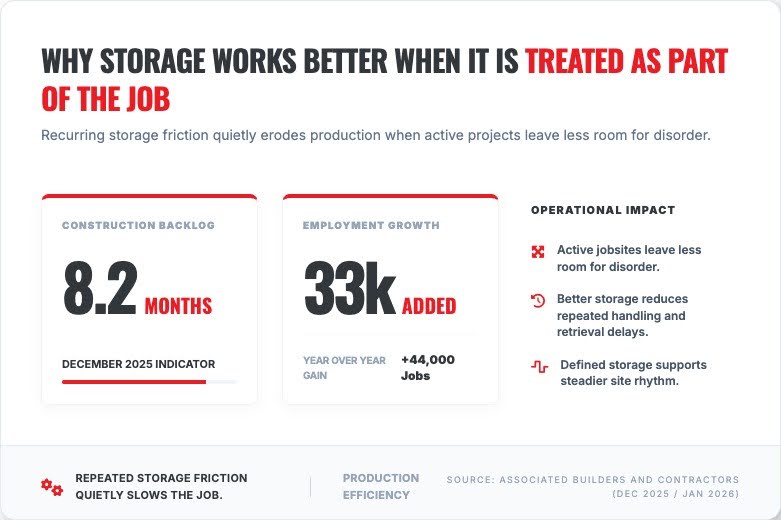
Containerized storage changes that dynamic by creating a fixed, controlled point within the site. Instead of allowing storage to drift into scattered corners and temporary piles, the contractor gains a defined area for securing and staging important assets. That kind of structure helps the job work with less improvisation. It also makes it easier to maintain consistency even when conditions on-site begin to shift.
South Louisiana Jobsites Reward Better Storage Discipline
South Louisiana is a strong environment for this lesson because local job sites often have to manage outdoor exposure, changing weather conditions, multiple trades, and active delivery schedules simultaneously. Under those conditions, loose storage quickly becomes a liability. Materials left out too long may be exposed to moisture. Tools staged informally may become harder to track. A site that begins the week in decent order can drift into disorder if it lacks a reliable way to protect key assets between work periods.
A recent South Louisiana-focused article, Why Jobsite Storage Is Becoming a Bigger Operational Priority Across South Louisiana, argued that contractors are increasingly treating storage as part of site infrastructure rather than as overflow logistics. That local framing matters because it reflects a real operational shift. Contractors are learning that storage quality shapes how much disruption the site has to absorb. A more controlled storage plan does not solve every project challenge, but it does reduce a category of preventable problems that too often become normal on busy jobsites.
Containerized Storage Helps Reduce Exposure
One of the most practical lessons contractors can take from containerized storage is that exposure is often the true risk behind many site problems. Materials are exposed to the weather. Tools are exposed to theft opportunities. Inventory is exposed to disorder when no one has a clear place to put it. A site may think it has a space problem when it really has an exposure problem. Better storage helps solve that by reducing the amount of the job’s critical inventory that remains vulnerable at any given time.
A container gives the site a secure footprint that is harder to replicate with ad hoc staging. It creates a place to lock down valuable tools, hold materials that should not remain fully exposed, and separate what is needed later from what is needed now. That division matters because it helps preserve a cleaner site while reducing unnecessary movement. It also reduces the likelihood that crews will constantly rehandle items that should already have a stable location.
Better Storage Can Support Safer Material Handling
Another lesson is that better storage often supports safer site conditions. OSHA’s construction material storage rules make clear that stored materials should not pose hazards and should be stacked, blocked, interlocked, and limited to remain stable and secure.
That guidance is usually read through a safety lens, but it also points toward a broader site-management principle. A jobsite that stores materials in a more stable and organized way is generally easier to work on. Walkways stay clearer. Access points are easier to preserve. Material handling becomes more deliberate and less improvised. OSHA’s construction material storage standard reinforces the idea that storage quality affects the entire work environment, not just where inventory happens to sit.
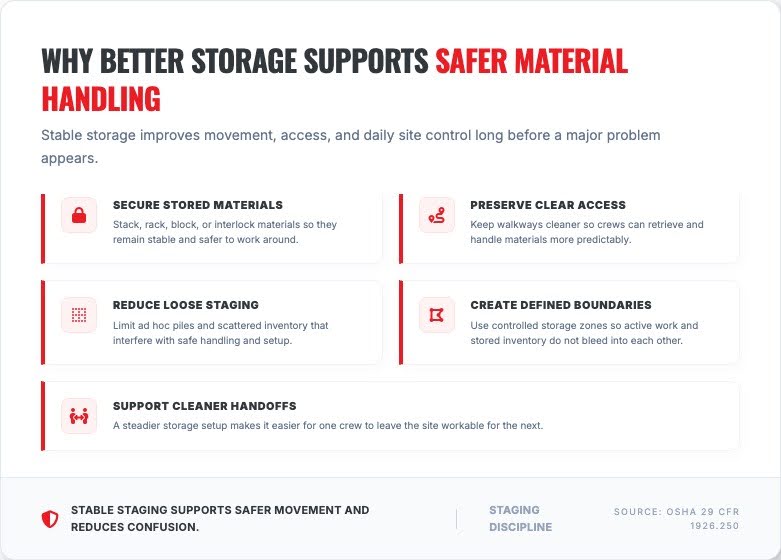
That is one reason containerized storage can have benefits that reach beyond security alone. It helps create boundaries. Once those boundaries exist, the contractor has a better chance of keeping the site more navigable, more predictable, and less vulnerable to clutter that slowly interferes with productive work.
Predictable Access Improves Daily Workflow
Contractors can also learn that predictable access matters as much as protected storage. A site does not become more efficient simply because items are present. It becomes more efficient when those items are stored in a way that makes them easier to retrieve and return without disrupting work. When crews know where important tools and materials are kept, they spend less time searching, less time asking around, and less time moving things that were placed without a clear system in place.
Containerized storage helps support that predictability because it allows the contractor to establish more consistent habits. The site gains a designated location for key assets. That makes it easier to separate daily-use items from backup inventory, to keep high-value equipment in a more controlled setting, and to reduce the amount of loose staging spread across the property. Those gains may seem modest in isolation, but on active job sites, they can noticeably improve the flow of the day.
Better Storage Creates Cleaner Handoffs Between Crews
Another operational lesson is that storage quality affects how well different crews can work around one another. On projects involving multiple trades, the site often changes character throughout the day or week. One crew finishes a task, and another begins. If materials and tools lack a stable storage plan, handoffs become rougher. The next crew inherits clutter, blocked access, or materials that were never properly staged for the next phase. That creates avoidable frustration and slows setup.
Better containerized storage supports cleaner handoffs by giving crews a more controlled way to reset the site between phases of work. Instead of leaving everything to informal judgment, the job has a defined place for items that should be secured, held, or separated from active work zones. That structure can make the site feel more manageable even when the schedule is moving quickly.
Compact Storage Can Still Deliver Operational Value
Some contractors assume that storage improvements require a large footprint to make a meaningful difference. In practice, even a compact storage setup can create real value if it is used strategically. A 20-foot container, for example, can function as a secure holding point for tools, supplies, and materials that would otherwise remain scattered or exposed. The point is not maximum volume alone. The point is creating enough protected, predictable storage to stabilize site operations.
A practical local example appears in this 20-foot shipping container rental overview, which reflects how contractors can use a modest container footprint to improve site organization without overcomplicating the storage plan. For many jobs, the value lies in the simplicity. A defined, lockable unit can reduce a surprising amount of site friction when it is intentionally integrated into the work.
Containerized Storage Encourages Better Planning Habits
Perhaps the biggest lesson of all is that better storage encourages better planning. Once a contractor starts thinking in terms of what should be protected, what should stay accessible, and what should remain off the open site until needed, the project usually becomes more deliberate in other ways as well. Storage planning naturally leads to better staging, cleaner sequencing, and greater awareness of how the physical site supports the schedule.
This is one reason containerized storage is worth considering as more than just a product rental. It is a way to bring more discipline to the project environment. That discipline often shows up in fewer small interruptions, fewer retrieval problems, and a steadier site rhythm overall. On a well-run project, those benefits matter because they keep minor issues from becoming part of the normal operating condition.
Why South Louisiana Contractors Are Likely to Keep Using This Approach
Contractors across South Louisiana are likely to keep learning from better containerized storage because the pressures that make it useful are not going away. Jobsites still need stronger control over materials, safer handling conditions, cleaner organization, and better protection from unnecessary exposure. As those priorities remain in place, containerized storage will continue to make sense not just as a convenience, but as a practical tool for site management.
That is the larger lesson. Better storage is rarely only about storage. It is about creating a site that works with fewer avoidable interruptions and more deliberate control. For contractors dealing with active, changing conditions, that can make a meaningful difference in how the project performs.
Conclusion
What South Louisiana contractors can learn from better containerized jobsite storage is straightforward. Storage matters most when it helps the site stay safer, more organized, and easier to operate. A container is useful not only because it holds materials but also because it provides protection, structure, and predictability in an environment that often lacks all three. On a busy jobsite, that kind of control is not a small advantage. It is one of the simpler ways to make the work run better.

