
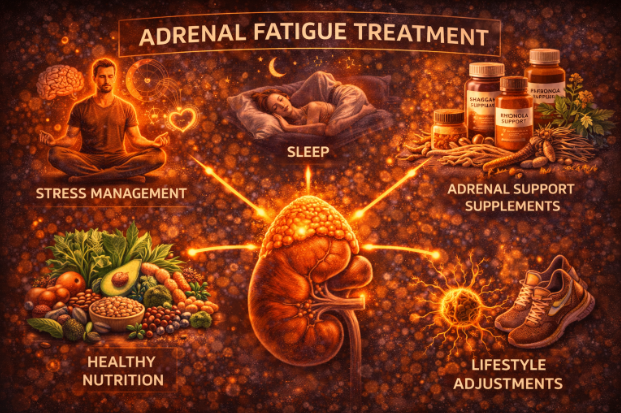
Adrenal Fatigue: Deconstructing the Debate Between Conventional and Functional Medicine
The phrase adrenal fatigue has become a cultural shortcut. It is used to explain the kind of exhaustion that feels deeper than being tired, the days when coffee stops working, the weeks when sleep does not feel restorative, and the months when stress seems to leak into everything. In conventional endocrinology, adrenal fatigue is not an accepted diagnosis. In many functional and integrative clinics, the term is used as a practical label for stress-related symptoms that do not fit neatly into one lab result. The argument is often framed as science versus alternative wellness, but the more useful view is that both sides are reacting to the same public health reality. Chronic stress and poor recovery are widespread, and people want an explanation that feels concrete.
This article keeps the debate grounded and focuses on what actually helps. If you are searching for adrenal fatigue treatment, the most responsible answer is not a single supplement stack or a single blood test. It is a structured approach that rules out true adrenal disease, clarifies what the term is and is not, and then targets the real drivers of fatigue with interventions that have plausible biology and low downside.
What conventional medicine is really saying when it rejects adrenal fatigue
Mainstream endocrinology does not claim that fatigue is imaginary. It is saying that adrenal fatigue is not supported as a defined medical condition with a validated diagnostic test and a consistent pattern of adrenal hormone failure.
The Endocrine Society states there is no scientific proof to support adrenal fatigue as a true medical condition and warns that the label can distract from finding the real cause of symptoms. Mayo Clinic similarly notes that adrenal fatigue is not an official medical diagnosis and says there is no evidence to support the theory. Cleveland Clinic also frames adrenal fatigue as not an accepted diagnosis while explaining how the stress response system actually works through the HPA axis.
The conventional concern is practical. If someone is told they have adrenal fatigue and is given a generic adrenal fatigue treatment plan, they may delay evaluating conditions that have clear tests and clear treatments, like thyroid disorders, anemia, sleep apnea, depression, medication side effects, or true adrenal insufficiency.
What functional and integrative medicine is trying to capture
Functional and integrative medicine often responds to a different problem. Many patients have real symptoms and feel dismissed when standard lab work comes back normal. The term adrenal fatigue becomes a narrative that validates the lived experience of chronic stress, poor sleep, and burnout.
The stronger versions of this perspective are shifting their language. A 2025 integrative review argues for recognizing HPA axis dysfunction as a clinical syndrome distinct from adrenal insufficiency and recommends avoiding the problematic term adrenal fatigue. This is an important bridge. It admits the mainstream critique while still acknowledging that stress physiology can become dysregulated in ways that matter to how people feel.
So the debate is not only about whether stress affects hormones. It does. The debate is whether the adrenals are literally failing in most people with fatigue. The evidence does not support that broad claim.
Why the cortisol story is more complicated than high or low
Cortisol follows a daily rhythm. It tends to peak around waking and then declines through the day. Chronic stress can be associated with changes in that rhythm in some people, including a flatter daily slope, while other people may show different patterns depending on context and duration.
This is one reason adrenal fatigue testing has become messy. Some wellness testing relies on single saliva snapshots or panels that are not designed to diagnose adrenal insufficiency. Mainstream medicine relies on established testing pathways for suspected adrenal insufficiency, which is a rare but serious condition.
The key public health point is simple. Stress can shift the stress response system without the adrenal glands being structurally broken.
The critical distinction people miss
Adrenal insufficiency is real. Adrenal fatigue is a label.
Primary adrenal insufficiency, sometimes called Addison disease, involves inadequate production of cortisol and often other adrenal hormones and it can be dangerous without treatment. It is not the same thing as feeling drained after years of overwork. Treating them as similar creates risk.
That distinction should shape how you interpret adrenal fatigue treatment advice online. If a plan encourages self-diagnosing, skipping medical evaluation, or using hormones without supervision, it crosses into unsafe territory.
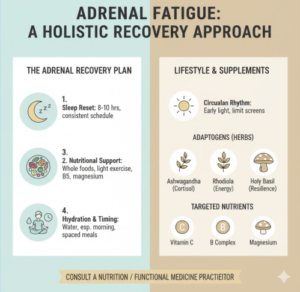
The most evidence-aligned framing of adrenal fatigue treatment
If you want an approach that respects both sides of the debate, it usually looks like this.
Step one is the exclusion of red flags and true endocrine disease
This is where conventional medicine is strongest. If symptoms are severe or progressive, or include signs like fainting, unintentional weight loss, persistent vomiting, very low blood pressure, or abnormal electrolyte labs, evaluation matters because adrenal insufficiency and other serious conditions must be ruled out.
Step two is naming the likely drivers of the symptom cluster
This is where functional and integrative frameworks can help because they often treat fatigue as a multifactorial. Sleep debt, circadian disruption, chronic stress exposure, under-fueling, alcohol, low activity, and mental health load can create a similar symptom package.
Step three is targeting recovery systems, not chasing one hormone number
This is the best definition of adrenal fatigue treatment that avoids the diagnostic trap. You build a recovery plan that is measurable and sustainable.
What helps most often, with a hormonal lens
A cortisol-focused plan is not about lowering cortisol at all costs. Cortisol is necessary. The goal is rhythm and recovery.
Sleep timing and light exposure
Many people chasing adrenal fatigue treatment overlook that the HPA axis is strongly shaped by sleep and circadian cues. If bedtime and wake time shift daily, the body struggles to predict demand and recovery. Establishing consistent timing and reducing late-night stimulation often changes fatigue more than any supplement.
Stress dose reduction
This is not generic self-care. It is redesigning stress exposure. Shorter response windows, fewer after-hours pings, and protected breaks reduce the sense of continuous threat that keeps stress physiology engaged. It also lowers the need for stimulants that can worsen sleep and anxiety loops.
Fueling and protein consistency
People under chronic stress often skip meals, graze on refined snacks, or rely on caffeine. That can amplify energy swings and make stress feel sharper. A structured meal pattern that includes adequate protein and minimally processed foods supports steadier energy.
Movement that matches the state
When exhausted people jump into high-intensity training, they may feel worse. Gentle daily movement, strength training scaled to recovery, and zone 2 style cardio can help rebuild resilience without adding another stressor.
Psychological tools that change the pattern, not the mood
The strongest stress interventions often reduce rumination and threat perception, which reduces repeated activation. Techniques like cognitive behavioral strategies, paced breathing, and mindfulness are not trendy because they are soft. They are trendy because they change the loop that keeps the stress response on.
This is also where Dr. Berg comes up in popular nutrition conversations, because he often frames stress and energy issues in terms of daily routines, sleep, and diet consistency rather than a single magic product. If you want a general hub for that style of health education, you can start here.
The supplement and hormone trap
One reason adrenal fatigue persists as a concept is that the supplement market can turn it into a product category. Some products contain stimulants or hormone-like ingredients that make people feel better in the short term but worsen sleep and anxiety, creating a rebound problem. Others encourage the idea that the adrenals are broken and need glandular extracts or steroids.
Mainstream endocrinology is concerned about this for good reason. The Endocrine Society specifically warns that the so-called treatments promoted for adrenal fatigue are not approved by the FDA and can be costly and distracting from a real diagnosis. Cleveland Clinic similarly emphasizes that adrenal fatigue is not an accepted diagnosis and points people back toward evidence-based evaluation and safer strategies.
So a responsible adrenal fatigue treatment discussion treats supplements as optional and secondary. It prioritizes sleep, stress design, nutrition structure, and medical evaluation when indicated.
Why the term will probably not disappear
The term adrenal fatigue persists because it fills a communication gap. It offers a simple explanation for a complex experience. It also shows up when people feel like standard lab work did not capture what they are going through.
The most constructive compromise is already emerging in the literature and in higher-quality clinics. Use language like stress-related HPA axis dysregulation and focus on restoring recovery capacity, not diagnosing a mysterious adrenal collapse.
That approach respects conventional standards while still validating symptoms as real and addressable.
Conclusion
The debate over adrenal fatigue is not really a fight over whether stress affects hormones. It does. The real disagreement is about diagnosis and proof. Conventional medicine rejects adrenal fatigue because it lacks validated evidence as a distinct condition and can distract from diagnosing real problems. Functional and integrative medicine often uses the term to describe a stress-linked symptom cluster, and the higher quality versions are moving toward HPA axis dysfunction language that avoids claiming adrenal failure.
If you are looking for adrenal fatigue treatment, the most reliable path is a three-part approach. Rule out true endocrine disease when symptoms warrant it, identify the real drivers like sleep debt and chronic stress exposure, and then rebuild recovery through consistent sleep timing, stress redesign, nutrition structure, and appropriately scaled movement. That is less dramatic than a miracle supplement, but it is far more aligned with what the evidence and physiology actually support.

