
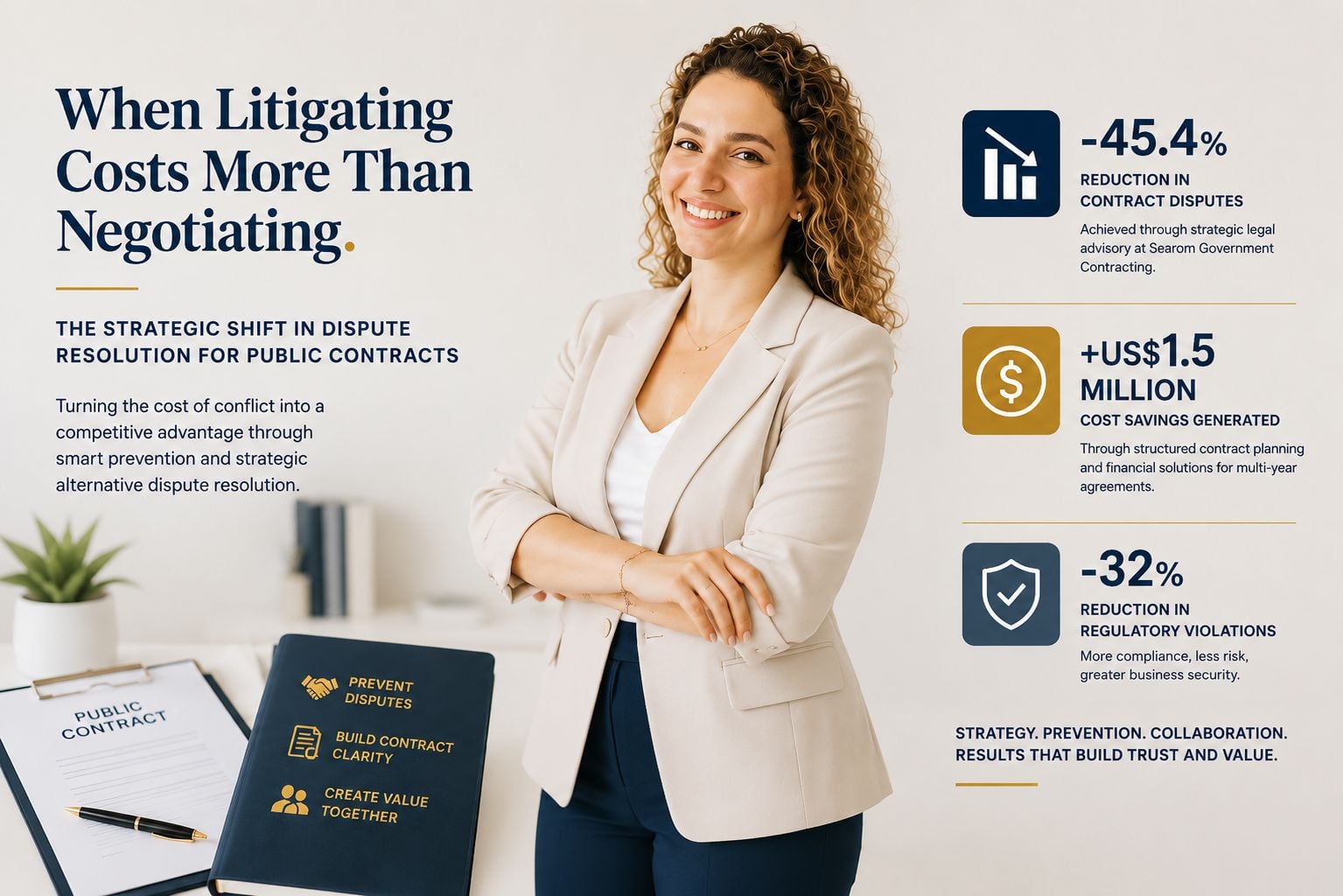
When Litigating Costs More Than Negotiating
The Strategic Shift in Dispute Resolution for Public Contracts
By: Taylor Whitman
In the world of government contracting, conflict is often treated as an inevitability. Missed deadlines lead to disputes. Ambiguous deliverables spark litigation. And when both sides dig in, the original goal — delivering a service, completing infrastructure, serving the public — gets buried under legal fees and delays. Juliana Beatriz Moraes Miura has spent her career proving that it doesn’t have to be this way. The Brazilian-born attorney and researcher achieved a 45.4% reduction in contract disputes during her tenure as in-house counsel at Searom Government Contracting — not by winning more battles, but by preventing most of them from ever starting.
Alternative dispute resolution (ADR) — encompassing direct negotiation, formal mediation, and arbitration — has existed in the legal toolkit for decades. But its systematic, preventive application in government contracts, particularly in Latin America, remains the exception rather than the rule. That gap is precisely where Miura has built her expertise.
The Hidden Problem in Public Contracts
Public contracts carry a structural asymmetry unlike almost any other area of law. On one side stands the government — bound by formal requirements, rigid timelines, and multiple layers of bureaucratic approval. On the other, private companies that need predictability to plan resources, manage cash flow, and meet deliverables. When expectations aren’t aligned from the outset, conflict becomes nearly inevitable.
“Litigation in public contracts rarely resolves the underlying problem,” Miura explains. “It prolongs uncertainty, consumes resources on both sides, and frequently leaves the actual purpose of the contract — the service, the project, the public good — as an afterthought. Strategic mediation begins long before a dispute ever surfaces: in how you read the procurement notice, how you assess risk, how clearly you define milestones, and how you build trust with the contracting authority from day one.”
That preventive approach grew directly from more than a decade of frontline experience. Before stepping into a leadership legal role, Miura spent years as a paralegal and then as an attorney working on contracts ranging from public infrastructure projects to state-level service agreements. Along the way, she identified recurring patterns in how conflicts emerged — most of them rooted not in bad faith, but in communication failures, contractual ambiguity, and the absence of preventive oversight mechanisms.
Mediation as Strategic Governance, Not a Last Resort
In the conventional legal imagination, ADR mechanisms are activated once conflict has already set in — a less costly off-ramp from the courthouse. Miura argues for a fundamentally different model: ADR as a governance instrument, integrated into contract design from the very beginning.
In practice, this means embedding specific dispute-resolution clauses in contracts — requiring mandatory direct negotiation steps before any formal escalation — and, more critically, establishing a culture of structured documentation and communication that surfaces divergences before they become entrenched positions. Every clearly defined deliverable, every documented project milestone, every meeting captured in written minutes narrows the margin for conflicting interpretations.
“Effective mediation demands the ability to listen and synthesize,” she says. “You need to understand what the other party actually needs — which is often not what they’re formally requesting — and build a solution that genuinely works for both sides. In public contracts, that also means understanding the legal constraints facing the government official, who cannot concede on certain points without regulatory justification. Ignoring that reality doesn’t help anyone.”
“The goal isn’t to win every dispute. It’s to build systems where most disputes never need to happen.”
From Theory to Measurable Results
The numbers from Miura’s time at Searom Government Contracting speak for themselves. Across a public contract portfolio valued at approximately $5 million, her work as in-house counsel produced more than $1.5 million in cost savings through structured contract planning and multi-year financial arrangements — alongside a roughly 32% reduction in regulatory violations.
But Miura is quick to frame those figures in their broader context. “Every well-executed contract creates positive precedent,” she explains. “The public agency learns to trust the company; the company gains a clearer understanding of what the agency actually needs. That accumulated trust is nearly impossible to quantify on a spreadsheet — but it’s the most valuable asset in any long-term public contracting relationship.”
ADR Across Borders: New Systems, Same Principles
Relocating to the United States expanded Miura’s scope — and tested the portability of her methods. Operating in a common law environment with distinct negotiation norms and compliance expectations required adaptation, but not abandonment of core principles. Her work at the City of San Diego — where she coordinated cross-departmental project initiatives and led a team of management interns — and her later role mediating between clients, insurers, and technical teams in the private sector reinforced a central conviction: the fundamentals of effective conflict management translate across legal systems.
“What changes across legal systems is form, not substance,” she observes. “In any environment, people want to be heard. They want their interests acknowledged. And they want a resolution that preserves the relationship wherever possible. That’s what well-conducted mediation delivers — and that holds in São Paulo as much as it does in San Diego.”
Her master’s degree in Political Science at San Diego State University — completed with the Presidential Graduate Research Fellowship and Terhune Political Science Scholarship — added an important analytical layer to this trajectory. Graduate study in governance theory, institutional design, and international relations provided conceptual tools for understanding not just how conflicts unfold, but why — and how well-structured systems can intercept them before competing interests harden into adversarial positions.
A Market That Still Undervalues Prevention
The global ADR market has grown significantly in recent years, driven by judicial system overload and corporate demand for faster, less costly resolution mechanisms. Yet Miura identifies a persistent paradox: many organizations still invest far more in litigating than in preventing. The full cost of prolonged legal proceedings — in attorney fees, executive time, reputational exposure, and operational disruption — frequently dwarfs what it would have taken to resolve the underlying issue at the source.
“There’s still a dominant mindset that conceding in a negotiation signals weakness,” she notes. “But in public contracting, where the relationship with the government client has to remain viable for years, negotiating rigidity is often the greatest risk of all. Knowing when and how to concede — while protecting what matters most — is a sophisticated skill. And it is profoundly underrated.”
Miura’s trajectory points to a professional profile that the legal market is increasingly recognizing as strategically essential: not the attorney who wins the most fights, but the one who prevents most of them from happening. In public contracting, where the resources at stake belong to the public and the consequences are shared by communities, that distinction carries more weight than almost anywhere else.
“The goal isn’t to win every dispute. It’s to build systems where most disputes never need to happen.” — Juliana Miura

