
Why the Dog Play Equipment in Your Facility Affects Retention, Reviews, and Revenue
Dog daycare and boarding facility owners spend a lot of time thinking about the things that are hardest to control — staffing, scheduling, difficult dogs, unexpected incidents. The things that are actually within their control and that have a direct, measurable effect on their business outcomes often get less attention than they deserve. The physical environment is one of them, and the dog play equipment inside that environment is one of the most significant levers a facility operator has for differentiating their business and keeping clients coming back.
This isn’t an abstract argument. The connection between what dogs experience at your facility and what their owners say about it — to you, online, and to their friends — is direct and consistent. Understanding that connection is the foundation of making smart decisions about your facility’s equipment investment.
What Dogs Actually Need During a Daycare Day
A dog that spends eight hours in a daycare environment has specific physical and psychological needs that the space either meets or doesn’t. Physical exercise is the obvious one, but it’s only part of the picture. Dogs also need mental stimulation, opportunities to rest in a space that feels secure, and structured variety that keeps the day from becoming monotonous in ways that lead to overstimulation and reactive behavior.
Facilities that provide only open floor space for play — no elevation changes, no platforms, no structures that create varied zones within the room — typically see more conflict between dogs as the day wears on. Without environmental complexity, social interactions tend to escalate because there’s no variation in the space to break up the dynamic. Dogs can’t self-regulate by moving to a higher vantage point, retreating to a quieter corner behind a structure, or choosing a lower-stimulation area when they’ve had enough of the main group.
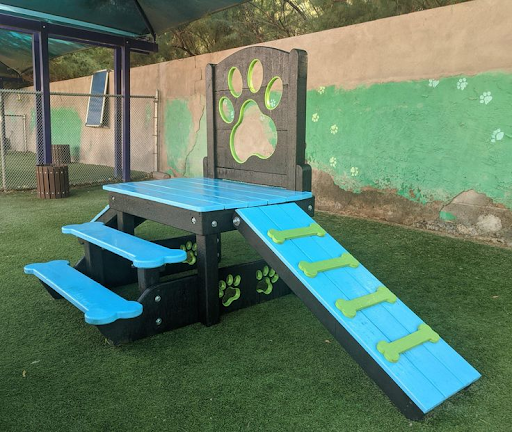
Commercial dog playground equipment solves this by creating environmental complexity that serves multiple purposes simultaneously. Ramps and platforms give dogs vertical options, which distributes the play space across more dimensions and reduces the density of social interaction at floor level. Elevated surfaces also give dogs a preferred perching spot that many will choose voluntarily when they want a break from the group without fully removing themselves from the activity — which is exactly the kind of self-regulation that keeps the group dynamic stable throughout a long daycare day.
The Direct Line Between Equipment and Client Retention
Dog owners are observant about their animals in ways that most people outside the industry underestimate. They notice energy levels when they pick up their dog at the end of the day. They notice whether the dog seems appropriately tired versus overstimulated and frantic. They notice when their dog pulls toward the facility entrance on arrival — and they equally notice when the dog hesitates.
Facilities where dogs are appropriately stimulated, well-managed, and returning home calm and satisfied generate a specific pattern of owner response: they rebook immediately, they bring the dog more frequently, and they refer friends without being asked. Facilities where dogs come home overstimulated, under-exercised, or showing stress signals generate the opposite — owners reduce frequency, stop mentioning the facility to others, and eventually switch.
The physical environment is one of the primary inputs that determines which pattern plays out. A well-equipped play space with varied structures, appropriate rest zones, and clear separation between activity areas and recovery areas produces better behavioral outcomes for the dogs — which produces better outcomes for the business. The investment in quality dog exercise equipment and play accessories isn’t separate from the business case; it is the business case, expressed in the form of a physical space that delivers on what clients are paying for.
Why Commercial-Grade Durability Is Non-Negotiable
Consumer-grade equipment in a commercial environment is one of the most predictable ways to create an ongoing maintenance problem. Products not designed for the stress of multiple large dogs interacting with them daily — jumping onto platforms, chewing edges, running up ramps at full speed — show failure within months. Broken edges create injury hazards. Unstable structures create liability exposure. Constant replacement costs erode the economics of the initial lower price point quickly.
Commercial-grade materials designed specifically for facility use have load ratings, surface treatments, and joint construction that are calibrated for daily heavy use across multiple years. The equipment that’s still in service at a facility five years after purchase looks different from consumer alternatives — both literally and in terms of how much it’s cost the facility over that time period.
For facilities building out a new space or upgrading an existing one, dog daycare equipment packages designed around specific footprints and dog population sizes make the configuration decision significantly more straightforward than specifying individual pieces without a spatial plan. The right package for a 1,500-square-foot play room is a different configuration than the right package for a 3,000-square-foot facility with a separate small dog area, and getting that configuration right from the start avoids the expensive and disruptive process of reorganizing a space that wasn’t set up correctly initially.
The Resting Environment Is Part of the Equipment Conversation
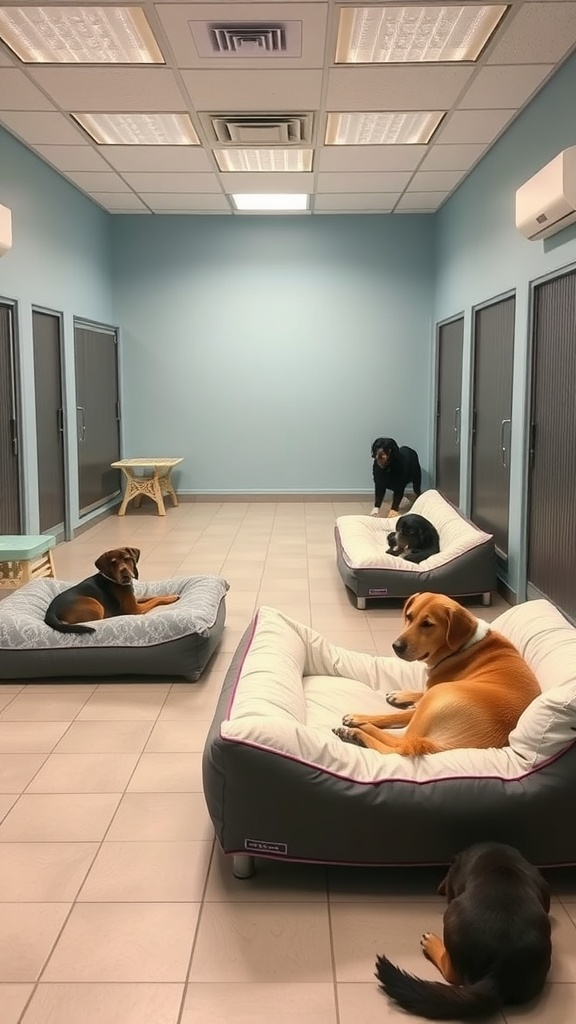
Play equipment gets most of the attention in facility design conversations, but the rest environment matters just as much to the overall quality of the dog’s experience. Dogs in daycare need genuine opportunities to decompress between active play periods — not just to lie on a concrete floor in a corner, but to rest in a way that actually allows their nervous systems to recover before the next social interaction.
Durable facility beds and soft rest furniture designed to withstand the chewing, scratching, and heavy use of a commercial environment are as much a part of the facility’s equipment investment as the play structures themselves. Facilities that provide quality rest options see calmer, more balanced dogs throughout the day — which translates directly into fewer incidents, more consistent behavior, and the kind of outcomes that keep clients coming back week after week.

