
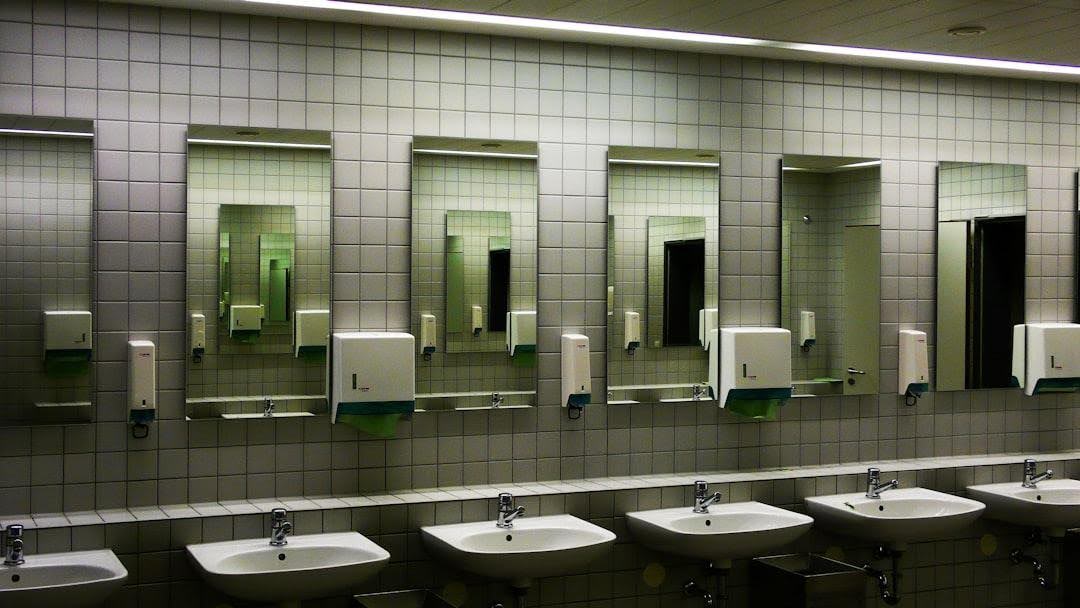
Why Restroom Mirrors Fail at the Frame Before the Glass
Mirror replacement in commercial restrooms is rarely prompted by damaged glass. It is prompted by edge deterioration, corrosion at the frame, and the dark spotting that spreads inward from the perimeter.
That pattern points at moisture reaching the reflective backing, which is a framing and sealing problem rather than a glass problem.
What Actually Causes the Spotting?
The dark spots spreading from mirror edges are deterioration of the reflective backing where moisture has penetrated. Once it begins, it progresses inward.
The entry point is almost always the edge, where the backing is most exposed. Sealing and framing determine whether moisture reaches it.
Why Are Restrooms So Hard on Mirrors?
Commercial restrooms combine elevated humidity, direct water contact near sinks, and repeated cleaning with chemical products. Each contributes to edge exposure.
Facilities replacing deteriorated units generally specify commercial restroom mirrors with stainless framing and sealed edges rather than matching whatever was there previously, since the original failure usually traces to inadequate edge protection. Replacing like for like reproduces the same failure timeline.
Cleaning chemicals applied to the mirror surface run down to the edge and collect there. That collection point is where deterioration begins.
How Does Framing Affect Longevity?
Stainless steel framing resists the corrosion that degrades other materials in humid environments. It also provides a physical barrier protecting the mirror edge.
Frameless installations expose the edge directly and depend entirely on edge sealing. They present well and generally require more careful specification.
What About Locker Rooms Specifically?
Locker rooms and pool facilities maintain humidity continuously rather than intermittently, which accelerates every failure mechanism. Mirrors in these spaces fail measurably faster.
Specification appropriate for an office restroom is frequently inadequate here. The environment warrants a different standard.
What Extends Mirror Life?
Several specification and maintenance factors determine how long a mirror lasts:
- Stainless framing or robust edge sealing
- Mounting that prevents water collecting behind the unit
- Cleaning products appropriate to the frame finish
- Cleaning technique that avoids saturating edges
- Adequate ventilation reducing ambient humidity
Cleaning technique is the most frequently overlooked. Spraying product directly at the mirror sends liquid to the edges.
How Should Cleaning Be Done?
Applying cleaning product to a cloth rather than spraying directly onto the mirror keeps liquid away from edges. This single change measurably extends service life.
It costs nothing and requires only staff instruction. Facilities that adopt it generally see the difference across a replacement cycle.
What Does Mounting Contribute?
Mounting that allows water to collect between the mirror and the wall creates a persistent moisture reservoir against the back of the unit. Proper mounting prevents that accumulation.
This is frequently the difference between two identical mirrors performing differently in the same room. Installation detail matters as much as product selection.
Are There Alternatives to Glass?
Polished stainless steel mirrors eliminate the backing deterioration mechanism entirely and resist breakage. They are common in facilities where vandalism or breakage is a concern.
Reflection quality differs from glass, which affects where they are appropriate. Many facilities use them selectively rather than universally.
What Should Be Checked During Inspection?
Inspecting mirror edges for early spotting identifies deterioration while it remains cosmetically minor. Once spotting reaches the visible field, replacement is generally required.
Catching it early does not reverse it, but it does allow replacement to be scheduled rather than triggered by complaint. Planned replacement costs less than reactive replacement.
What Should Specifiers Confirm?
Specifiers should confirm framing material, edge treatment, and suitability for the specific humidity conditions of the space. Manufacturers serving commercial markets distinguish these applications.
Verifying mounting height against accessibility requirements at the same time addresses both durability and compliance in one review.
What Security Options Exist?
Facilities with vandalism concerns can specify theft-resistant mounting, concealed fasteners, and shatter-resistant or metal mirror surfaces. These options add cost and reduce replacement frequency.
The calculation depends on documented history at a specific location rather than general concern. Facilities with repeated incidents generally recover the additional cost quickly.
How Should Sizing Relate to Sink Count?
Mirror sizing should scale with the number of sinks served, since an undersized mirror creates crowding during peak use. A continuous mirror across a multi-sink counter generally performs better than separate units.
Peak usage scenarios are worth walking through during design. A mirror adequate at low occupancy can be inadequate at shift change.
How Does Lighting Interact With Mirror Performance?
Poor lighting undermines a mirror’s usefulness regardless of its quality, and shadows across the reflective surface are a common complaint in commercial restrooms. Task lighting positioned to minimize shadowing improves the practical result.
Mirrors and lighting are frequently specified by different parties, which is how coordination gaps appear. A brief review during design development catches the mismatch.
How Should Replacement Be Budgeted?
Treating mirrors as a scheduled replacement item rather than a reactive one allows the cost to be planned across a portfolio. Deterioration timelines are reasonably predictable once environment is accounted for.
Facilities that track installation dates can anticipate replacement rather than responding to complaints. That planning generally reduces both cost and disruption.
Mirror failure in commercial restrooms begins at the edge, which makes framing and edge sealing the specifications that determine service life.
For facility teams, the practical steps are to specify stainless framing in humid environments and to apply cleaning product to a cloth rather than spraying the mirror directly.

