When Flu Season Peaks and What It Means for Shared Offices
CDC guidance for offices and other community buildings.
In a small office, one cold can easily become several. One employee comes in with a cough, the break room coffee pot and the copier get touched all day, and by the end of the week three desks are empty.
Cleaning will not stop every illness, but it is one of the few parts of flu season an office manager can plan. In a Baton Rouge office with ten or twenty people sharing the same handful of surfaces, a simple plan set up before winter does more than a scramble after the first sick day.
Flu Season Has a Predictable Peak
The timing is not a mystery. The Centers for Disease Control and Prevention tracks the month when flu activity peaks each season, and its chart data covers 42 seasons, from 1982-1983 through 2023-2024.
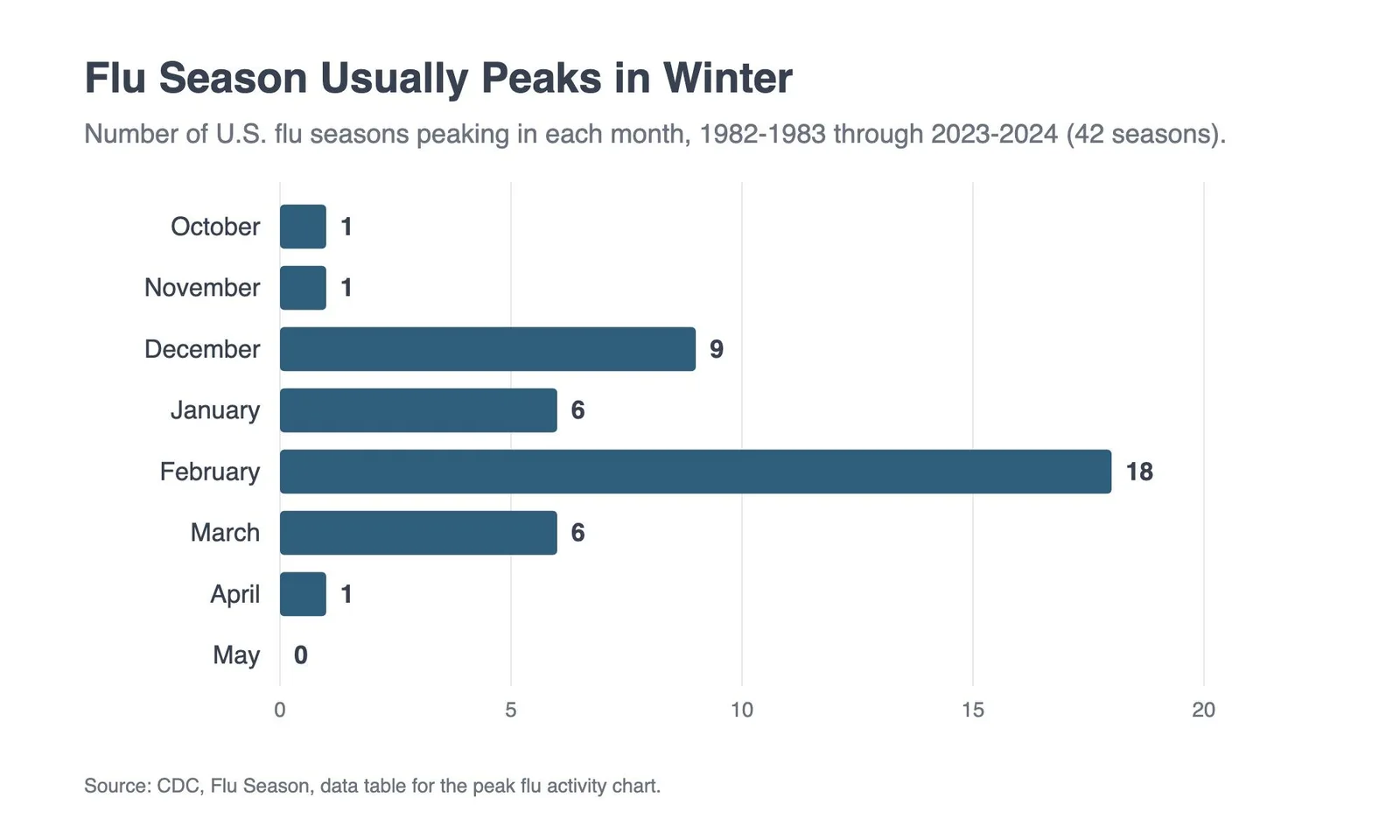
Flu activity peaked between December and February in 33 of 42 seasons.
February was the most common peak month, with 18 seasons. Activity peaked between December and February in 33 of 42 seasons, and the CDC notes that flu viruses spread year-round even though flu season usually runs through fall and winter.
For an office, that means the useful window to tighten cleaning routines is late fall. A plan in place by December covers the months when the risk tends to be highest.
Start With the Surfaces People Share
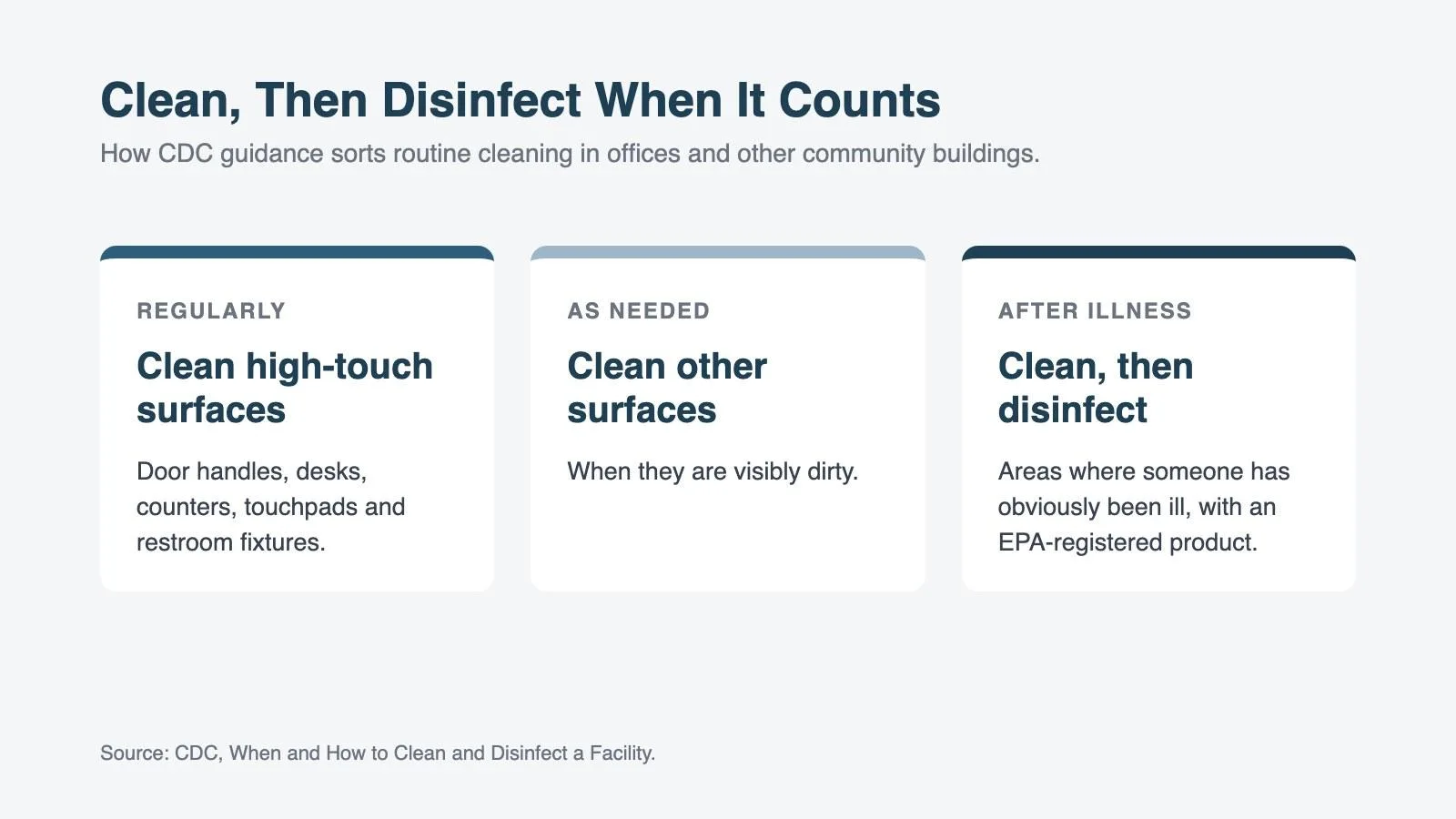
The core of the plan is short. CDC guidance on cleaning and disinfecting a facility applies to community buildings such as offices, and it says to clean high-touch surfaces regularly and other surfaces when they are visibly dirty.
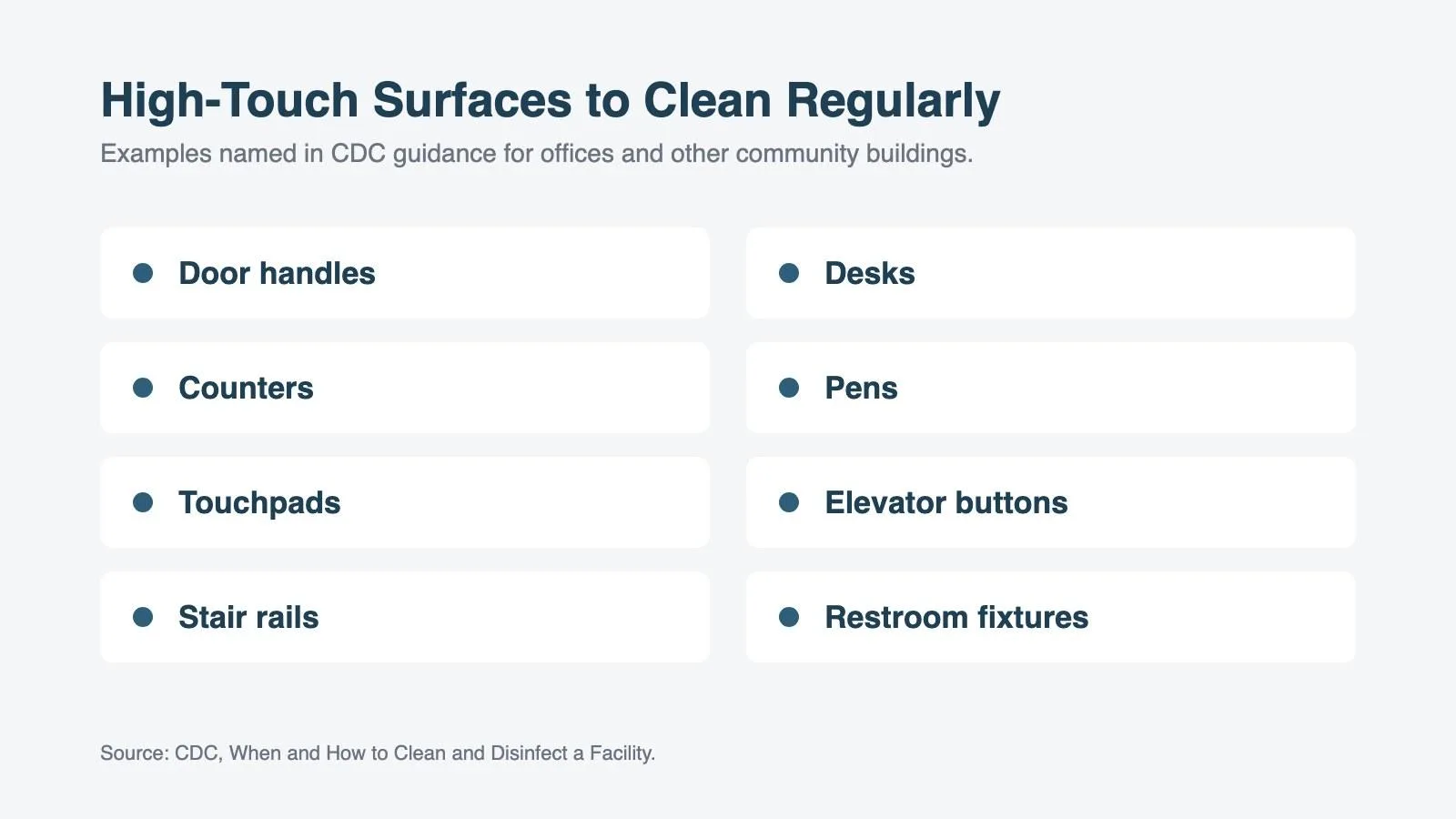
High-touch surfaces named in CDC’s facility cleaning guidance.
The agency’s examples read like a walkthrough of any small office: door handles, desks, counters, pens, touchpads, elevator buttons, stair rails, and restroom fixtures. In practice, shared equipment belongs on the same list, from the copier keypad to the break room refrigerator handle.
CDC also notes that high-touch surfaces are more likely to spread germs. In high-traffic areas, its guidance says an office may choose to clean more often or disinfect in addition to cleaning.
Clean First, Then Disinfect Where Someone Was Ill
Cleaning and disinfecting are not the same job. The CDC says cleaning with a soap or detergent cleaner removes most harmful germs, and in most situations, regular cleaning is enough. Disinfecting can kill harmful germs that remain on surfaces after cleaning.
The order matters. CDC says to clean surfaces before sanitizing or disinfecting them, because dirt can make it harder for the chemicals to kill germs.
Disinfection is the targeted step. CDC recommends it, in addition to cleaning, in areas where people have obviously been ill. Its guidance calls for an EPA-registered product suited to the germ, if it is known.
The product also needs time to work. CDC points to the contact time, or wet time, listed in the product directions and Safety Data Sheet, which is how long the disinfectant must stay on the surface to kill germs.
The label also says which surfaces the product suits. CDC advises checking the label for the type of surface being treated, such as a hard surface, a soft surface, or a food-contact surface like a break room counter.
A quick spray-and-wipe can skip the contact time entirely. Read the label once and post the contact time near the supply shelf.
A Simple Rhythm for a Small Office
Most small offices do not need a complicated schedule. They need a routine people actually follow, one that gets stricter at the right time of year.
A workable pattern looks like this:
- Every day: wipe down shared high-touch surfaces, restroom fixtures, and break room counters.
- Every week: clean surfaces people forget, such as chair arms, phones, light switches, and the refrigerator handle.
- When someone goes home sick: clean and then disinfect that person’s desk, phone and keyboard, plus the shared items they used.
- Before flu season: check supplies, confirm the disinfectant’s contact time and decide who covers each task.
None of this replaces sick leave or handwashing. It does keep the most-touched parts of the office from becoming the weak link.
The Legal Floor Is Low
Federal rules set a baseline, not a plan. OSHA’s sanitation standard requires employers to keep all workplaces clean to the extent the nature of the work allows.
That language leaves the details to the employer. A small business can meet the standard and still have a break room that spreads a cold through the whole staff, so the practical target sits well above the legal one.
Questions to Ask Before Hiring Help
Many small offices hand the job to a cleaning company. That works well when the scope is written down, and poorly when it is assumed.
A few questions sort out a good fit before flu season:
- Which high-touch surfaces are cleaned on every visit, and which are weekly?
- What disinfectant is used, and does the crew follow its contact time?
- How do you handle a request to disinfect after an employee goes home sick?
- How do you check that the work was done?
- Can the scope and frequency change as staffing or the season changes?
The answers should be specific. “We clean everything” is not a scope of work.
What a Local Plan Looks Like
A good provider starts with the building, not a price sheet. In Baton Rouge, Advanced Office Care is one company that describes its approach to office cleaning in Baton Rouge that way.
It begins with an office walkthrough covering layout, occupancy, and traffic flow. Then it builds a cleaning plan around the client’s schedule and staffing levels, and it runs regular quality checks.
Where Office Cleaning Is Heading
The calendar will not change much. Flu season will keep arriving in the fall and peaking in winter, and small offices will keep sharing the same door handles, keyboards, and coffee pots.
What changes is how prepared an office is when it starts. A plan set in late fall, built on CDC’s simple rules and written into any cleaning contract, gives a small Baton Rouge business a better chance of keeping its desks full through February.

