

The FAA’s Safety Management System Rule and On-Demand Charter Operators
Until recently, the federal rules requiring a formal safety management system in U.S. aviation applied only to the airlines. Charter companies that fly on demand worked under their own operating rules, without that requirement.
That changes in about six and a half months. A federal rule now gives on-demand charter operators until May 28, 2027, to build one, and to tell the Federal Aviation Administration they have done it.
What the 2024 Rule Requires
The FAA published its Safety Management Systems final rule in the Federal Register on April 26, 2024, at 89 FR 33068. It took effect on May 28, 2024.
Before this rule, the federal SMS requirements in Part 5 applied only to airlines operating under Part 121. The new rule extends them to commuter and on-demand operators under Part 135, to commercial air tour operators, and to certain aircraft design and production companies.
The FAA says it acted partly to meet a congressional mandate and partly in response to recommendations from the National Transportation Safety Board. It also says the rule brings the United States closer to Annex 19 of the international aviation convention.
An SMS, as the rule defines it, has four parts. They are safety policy, safety risk management, safety assurance, and safety promotion. The idea is to find hazards and reduce risk before an accident, rather than react after one.
The Deadline and the Paperwork
The current text of 14 CFR 5.9 is direct. A company that held Part 135 authority before May 28, 2024, must develop and implement an SMS no later than May 28, 2027. By the same date, it must submit a declaration of compliance to the FAA.
The FAA first proposed 24 months. After comments from industry, it extended the window to 36 months for Part 135 operators and air tour operators.
New applicants do not get the grace period. Any company applying for Part 135 authority on or after May 28, 2024, must have an SMS as part of the process.
The FAA says it will check compliance during routine surveillance. The rule also lists certain SMS provisions that do not apply to some single-pilot operations, because some requirements make little sense for a one-pilot company.
How Many Operators the Rule Reaches
The FAA estimated that about 1,848 Part 135 operators would be required to implement an SMS. That figure includes 203 companies that also hold authority to run commercial air tours.
Another 715 air tour operators without a Part 135 certificate are covered as well. The agency considered exempting single-pilot charter operators, which would have cut the Part 135 count to about 1,300, but did not adopt that option.
The preamble also explains why the FAA wanted the rule. Citing NTSB data, it says there were 215 accidents involving Part 135 operators from 2015 to 2019, with 121 deaths. The FAA identified 35 of those accidents with deaths and serious injuries that it said could have been reduced by an SMS.
A Decade of On-Demand Accident Records
The NTSB publishes its full accident case files as a free download. We counted accidents in the NTSB’s downloadable aviation accident database, using the November 1, 2026, release, and limited the count to nonscheduled Part 135 flights, which is how the agency codes on-demand charter.
As a check, the same database returns exactly 215 Part 135 accidents and 121 deaths for 2015 to 2019, the figures the FAA cites in the rule.
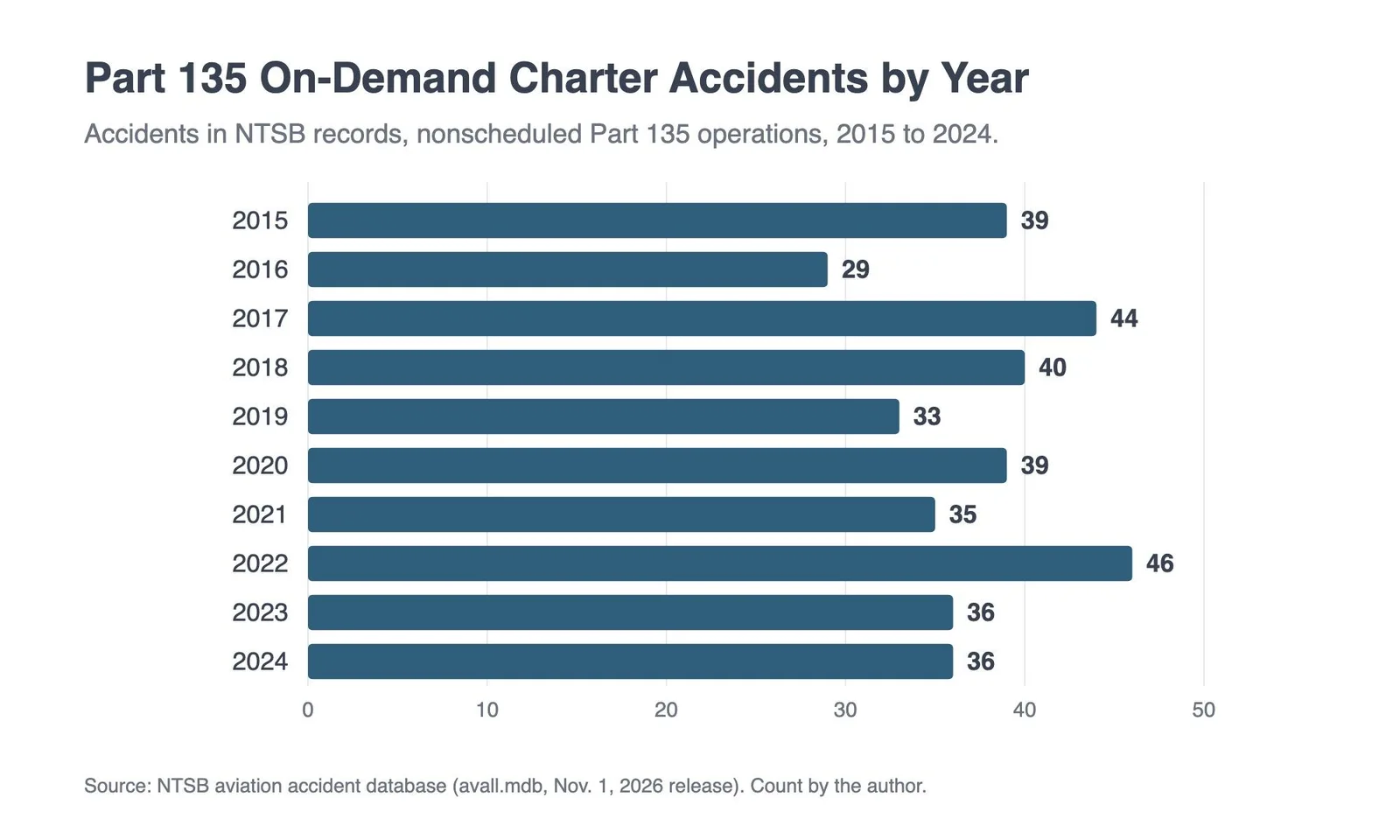
Part 135 on-demand accidents by year, 2015 to 2024.
From 2015 through 2024, the database holds 377 on-demand Part 135 accidents, an average of about 38 a year. The yearly count stayed between 29 and 46 for the whole decade.
These counts cover every aircraft type flown on demand. Of the aircraft involved, 248 were airplanes, and 131 were helicopters, so the totals reach well beyond private jets. They are also raw counts, not rates, because they do not account for how many hours were flown each year.
Fatal Accidents Year by Year
Of those 377 accidents, 74 involved at least one death, or about one in five by our arithmetic. Those accidents killed 201 people over the ten years.
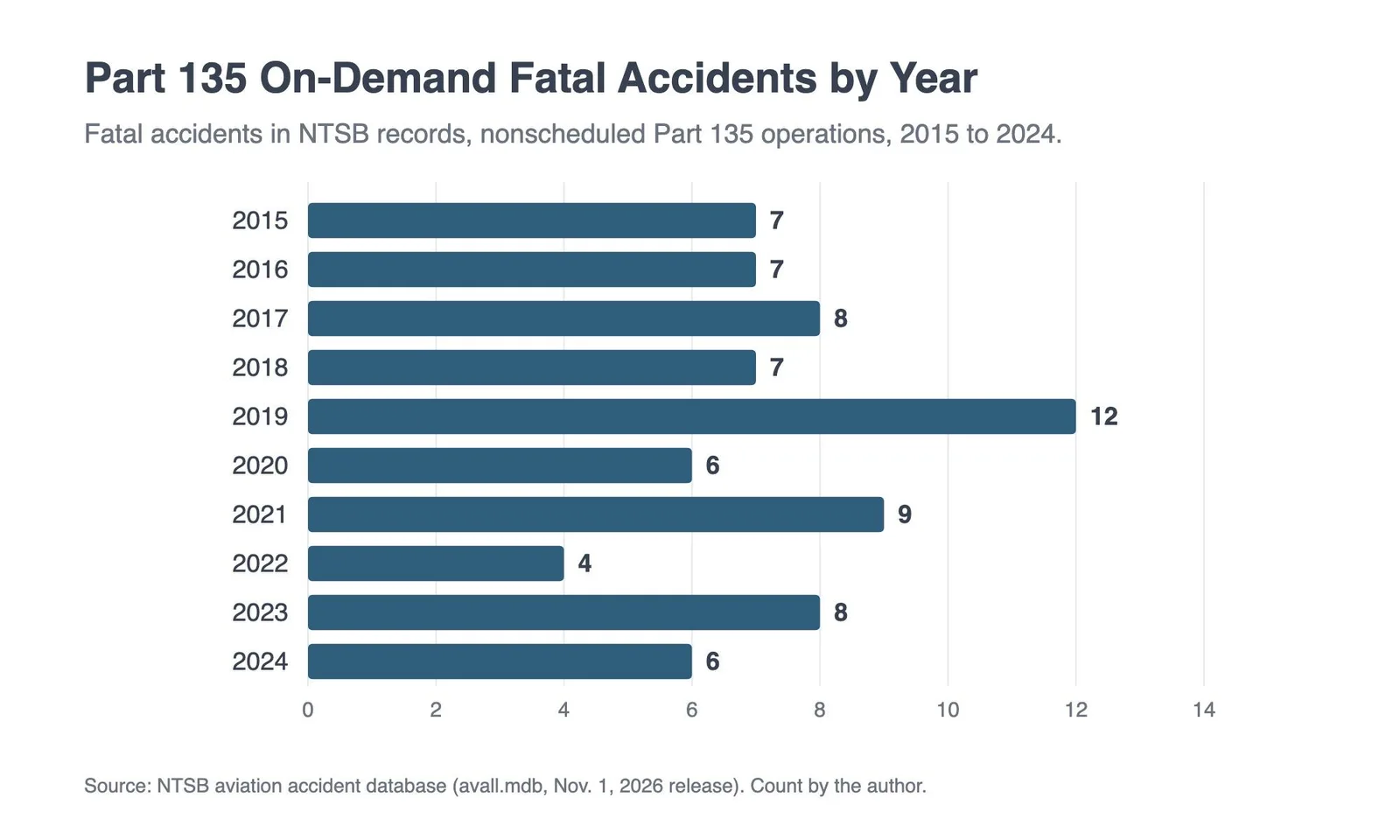
Part 135 on-demand fatal accidents by year, 2015 to 2024.
The worst year in the period was 2019, with 12 fatal accidents and 32 deaths. The lowest was 2022, with 4 fatal accidents and 8 deaths. In 2024, the last year in the period, there were 6 fatal accidents and 16 deaths.
The numbers move up and down without a clear trend. That is part of the case the FAA made for SMS, which is meant to catch hazards inside a company before they show up in an accident file.
What the Rule Means for Charter Buyers
An SMS is an internal system, so a passenger will not see it on the ramp. A buyer can still ask if an operator has implemented one. After May 28, 2027, a buyer can also ask if it has filed its declaration with the FAA.
Before that date, an operator without a finished SMS is not out of compliance. After that date, every Part 135 operator that held authority in 2024 is expected to have one.
Some buyers book through an air charter broker rather than directly. Under 14 CFR 295.24, a broker must give the customer the corporate name of the carrier in operational control of the aircraft before a contract is signed. That name is what a buyer needs to look up the operator’s record.
Where Private Audits Fit
Beyond the federal rules, some operators also go through private safety audits. Chronicle Jets, a charter broker, is one company that explains how charter brokers vet operators on its website, starting from a Part 135 certificate as the legal minimum for charter.
Its page describes ARGUS ratings of Gold, Gold Plus and Platinum, with Platinum requiring a two-day on-site audit and a mature safety management system. It also describes WYVERN’s Wingman Standard and Wingman PRO, and IS-BAO, a three-stage standard from the International Business Aviation Council launched in 2002, and it notes that these ratings belong to operators, not brokers.
A Date Worth Writing Down
The SMS rule does not change who may fly charter. It changes what a certificated operator must have in place, and it sets a firm date for it.
For business travelers and the people who book their trips, May 28, 2027, is a useful line on the calendar. After it, a formal safety system is no longer optional for operators that fly on demand. It is part of holding the certificate.

