
Why a Business Dumpster Keeps Overflowing Between Pickups
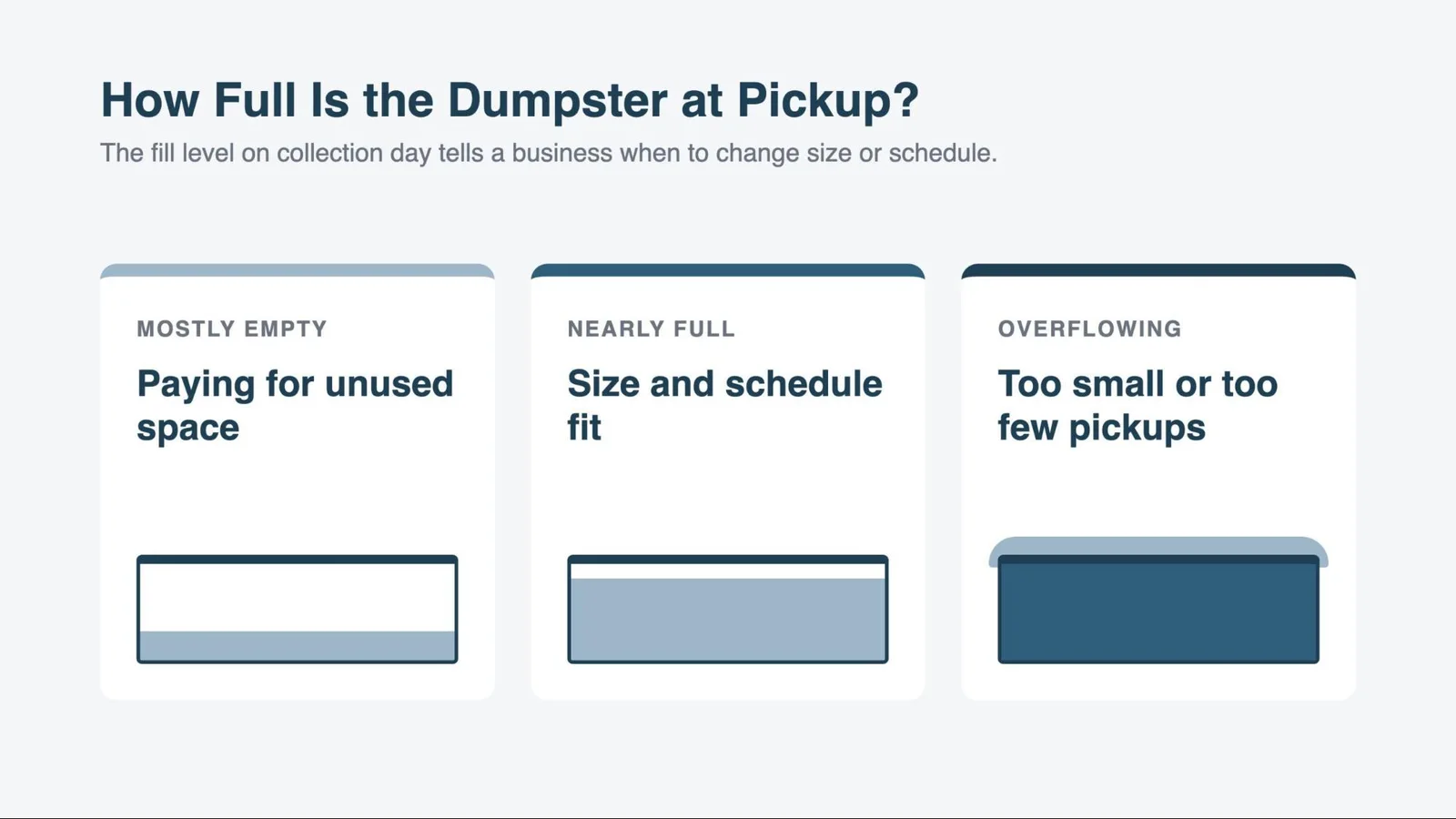
The fill level on collection day is the simplest sizing test a business has.
An overflowing dumpster rarely starts as a crisis. A lid that will not close, a few bags set beside the bin, a stack of boxes leaned against the enclosure. Within a week the back lot smells, birds and rodents find it, and a customer parks next to it.
For most small businesses the fix is not a bigger mess of rules. It is a better match between three things: what the business throws away, how big the container is, and how often it gets emptied. Getting that match right is mostly a matter of watching the bin for a few weeks and knowing a little about how waste behaves.
Dumpsters Fill by Volume, Not Weight
Commercial containers are sized in cubic yards, a measure of space. One cubic yard is a cube three feet on every side. A small business can fill that space long before the load gets heavy, because so much of what it throws out is light and bulky.
EPA’s volume-to-weight conversion factors, updated in April 2016, put numbers on that. Mixed commercial waste that has not been compacted weighs about 138 pounds per cubic yard. Flattened cardboard comes in at 106 pounds, shredded office paper at 128, and plastic foam packaging at just 32.
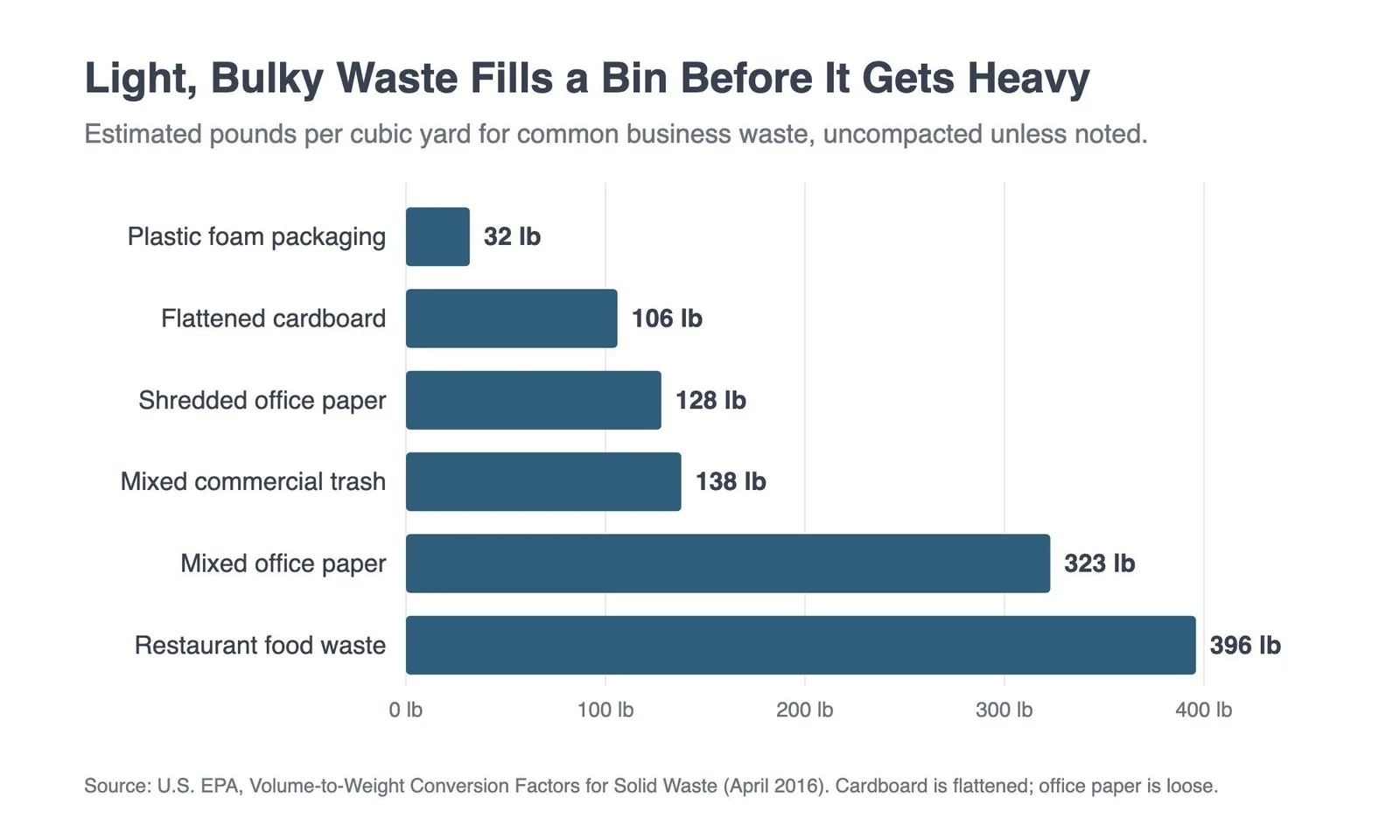
Estimated pounds per cubic yard for common business waste, from EPA conversion factors.
The arithmetic is useful. A 4-yard bin filled with uncompacted commercial trash holds about 552 pounds. The same bin filled with flattened cardboard holds about 424 pounds. Either way, the lid stops closing at a weight most businesses would call modest.
Foam is the extreme case. At 32 pounds per cubic yard, it weighs under a quarter of what mixed trash does, so a few large shipments packed in foam can take up a surprising share of the container.
Know What Is Actually in the Bin
Before changing anything, it helps to know what fills the container. National data gives a starting point. In EPA’s Facts and Figures report, which is current through 2018, the United States generated 292.4 million tons of municipal solid waste that year, or 4.9 pounds per person per day.
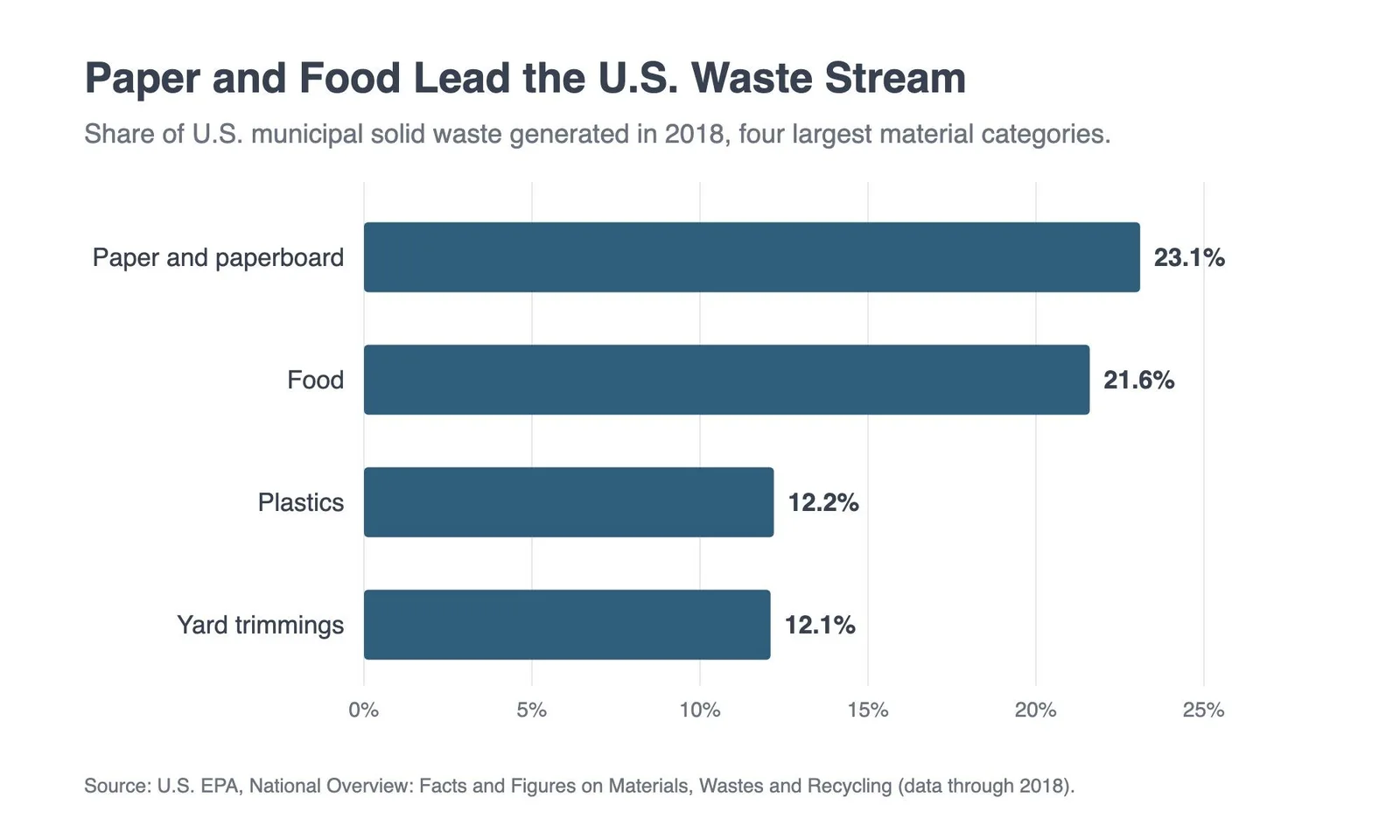
Paper and food were the two largest materials in U.S. trash in 2018.
Paper and paperboard made up the largest share, at 23.1 percent of generation. Food was next at 21.6 percent, followed by plastics at 12.2 percent and yard trimmings at 12.1 percent. EPA also reports that containers and packaging accounted for 82.2 million tons, or 28.1 percent of the total.
Those are national figures that blend homes and businesses, but the pattern shows up behind most storefronts. Retailers and offices produce boxes and paper. Restaurants produce food waste and packaging. A quick look inside the bin on a normal week tells an owner which of those profiles fits.
Two Dials: Container Size and Pickup Frequency
Every commercial waste setup has two dials. One is the size of the container. The other is how many times a week it is emptied. An overflow problem can be solved with either one, and the right choice depends on the waste.
Steady, everyday trash usually goes in a front-load container, the lidded bin that sits behind a building and is emptied on a regular route. Common sizes are 2, 4, 6 and 8 cubic yards. One-time loads from a renovation or cleanout belong in a roll-off container, the open-top box that is delivered for a project and hauled away when full.
Food waste changes the math because it is dense and it rots. EPA’s factors put restaurant food waste at 396 pounds per cubic yard, close to three times the weight of mixed commercial trash. A bigger bin emptied once a week can leave food sitting for days in the heat. For a restaurant, an extra pickup day often does more than an extra yard of space.
Dry, bulky waste points the other way. A store that mostly throws out cardboard may do fine with a larger container on the same schedule, or with less volume in the trash bin altogether.
A Simple Way to Find the Right Fit
The most reliable sizing test costs nothing. For three or four weeks, someone checks the bin right before each pickup and notes how full it is.
- If it is mostly empty on collection day, the business is paying for space it does not use. A smaller container or fewer pickups may fit.
- If it is nearly full and the lid still closes, the size and schedule are about right.
- If it is overflowing, or bags are piling up beside it, the container is too small, or the pickups are too far apart.
- When it overflows only on certain days, such as after weekend sales or a delivery day, the schedule matters more than the size.
Seasonal peaks deserve their own note. Holiday retail, festival weekends and back-to-school traffic can push a bin past its limit for a few weeks. Asking the hauler about a temporary extra pickup is worth doing before committing to a larger container all year.
Cut Cardboard Volume Before It Hits the Bin
Cardboard is the easiest place to recover space. Breaking boxes down flat before they go in the container keeps them from trapping air. A separate recycling container or cardboard pickup takes the bulkiest material out of the trash bin entirely.
EPA reports that corrugated boxes had a recycling rate of 96.5 percent in 2018, well above the rate for newspapers or other paper packaging. Boxes are among the most widely recycled items there are, so a business that fills its trash bin with cardboard is often paying to landfill space it could free up.
The Legal Floor for a Workplace
Federal rules set a baseline for how waste is handled at work. OSHA’s sanitation standard says a receptacle for waste that can rot must not leak and must be easy to clean. It also calls for a solid, tight-fitting cover unless the receptacle can be kept sanitary without one.
The same standard says waste must be removed as often as necessary to keep the workplace sanitary. A bin with its lid propped open by overflow, attracting flies, is hard to square with that language.
Local rules on enclosures, screening and litter vary by city and parish, so a business should check with its local government before moving or adding a container.
Questions to Ask a Hauler
A good hauler sizes the service around the business, not around a standard package. Before signing an agreement, it helps to ask:
- What container size do you recommend for this type of business, and why?
- How many pickups a week does that size assume?
- Can extra pickups be added for busy weeks or seasons?
- Is there a separate option for cardboard or recycling?
- How easy is it to change the size or schedule later?
The answers should come from the business’s actual waste, not from a one-size price sheet.
What It Looks Like in Practice
Local sizing guides follow the same logic. One Baton Rouge guide to commercial dumpster rental in Baton Rouge separates steady weekly waste, which suits a front-load bin, from one-time project debris, which suits a roll-off.
It notes that most mid-size restaurants fit a 4-yard front-load container. A high-volume restaurant often steps up to a 6 or 8-yard bin, or adds an extra pickup day, so the container never overflows between hauls.
The Takeaway for Small Business Owners
An overflowing dumpster is a signal, not a mystery. Most of the time the cause is light, bulky waste filling the space, food waste sitting too long between pickups, or a schedule that does not match the busy days.
A few weeks of checking the bin before each pickup, a habit of breaking down boxes and one honest conversation with the hauler will fix most of it. The goal is a lid that closes on collection day, every week.

