

From Resale to Daily Function: What Is Actually Driving Bathroom Remodel Decisions Right Now
Bathroom remodeling is often discussed in terms of return on investment, but that explanation rarely captures the full reason homeowners pursue the project. The stronger truth is that bathroom decisions usually happen where resale awareness and everyday function overlap. A homeowner may begin by considering market value, but the remodel gains momentum because the room no longer functions well enough in daily life. The lighting is weak. The storage is poor. The shower feels outdated or awkward. The finishes are hard to clean. The room asks for too much patience. That blend of immediate frustration and long-term value consideration is what makes bathroom projects especially active right now.
Why Bathroom Remodeling Is About More Than Resale
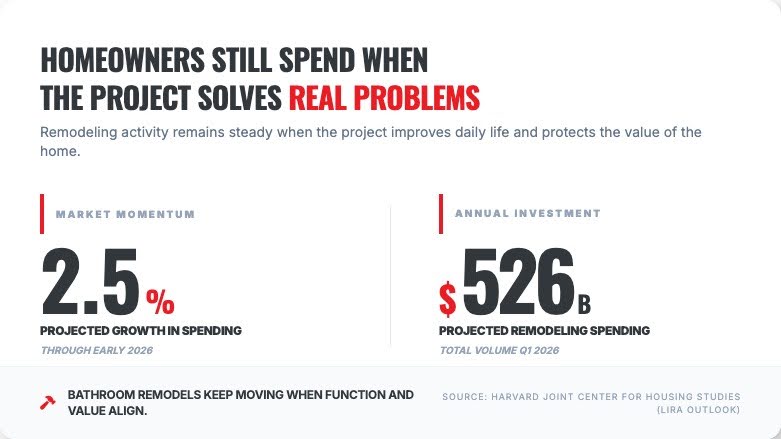
The national renovation picture supports that interpretation. The Harvard Joint Center for Housing Studies’ outlook on remodeling activity has indicated renewed growth in spending, suggesting that homeowners remain willing to invest when the case is compelling. Bathrooms often meet that standard because they are among the few spaces where a project can improve both lived experience and property perception at the same time. This is not a matter of aesthetics alone. A better bathroom can reduce daily friction, support mobility, improve cleaning routines, and signal that the home is being maintained with care.
Older Homes Are Making Bathroom Problems Harder to Ignore
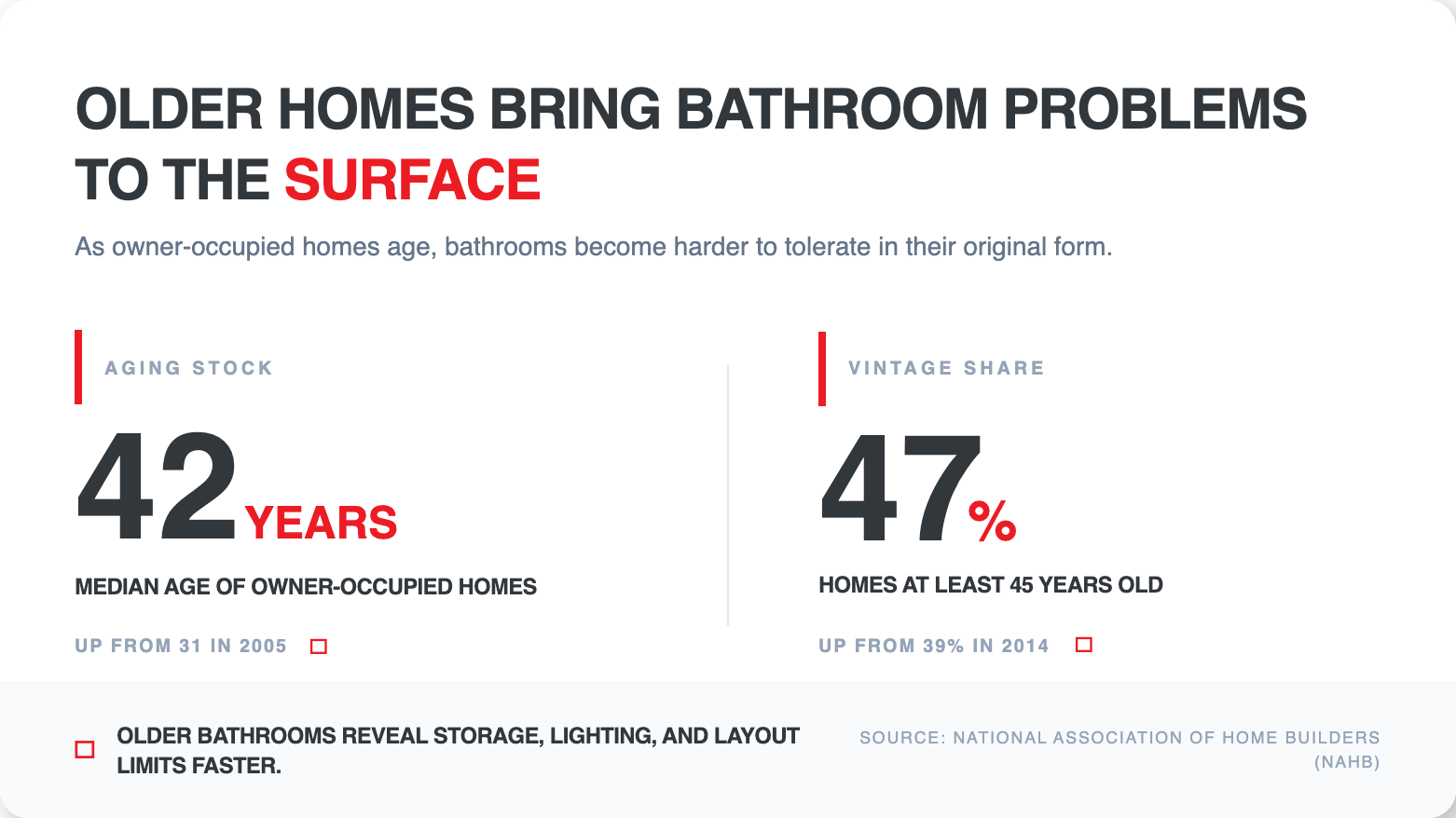
That logic becomes even clearer when the housing stock is older. The NAHB review of current housing age trends shows that owner-occupied homes have aged significantly, and that matters because older bathrooms tend to reveal their limitations more quickly than many other rooms. They were built for different assumptions about storage, lighting levels, fixture performance, and circulation. A dated guest room may be tolerable. A dated bathroom is encountered constantly. That difference turns the room into a high-priority zone where practical needs outrun cosmetic tolerance.
The Frankfort Example Shows the Broader Pattern
A local case study, “Why Bathroom Remodeling Demand Is Rising in Frankfort, Indiana,” illustrates how those larger trends manifest in a real market. The Frankfort example is useful because it reflects homeowner behavior in a place where renovation decisions are typically grounded in practicality. The argument was not that local homeowners are suddenly pursuing luxury bathrooms in large numbers. They are increasingly willing to invest in rooms that affect everyday quality of life and still make sense within the overall value of the property. That distinction matters. It helps explain why bathroom remodeling can accelerate even when consumer spending remains selective.
Daily Function Is Often the Real Trigger
The daily-function side of the equation is often underestimated. A bathroom shapes the beginning and end of the day, and in many households, it must support multiple users on a predictable schedule. When the room is poorly lit, undersized, lacking storage, or awkwardly arranged, that friction compounds. It is not just an inconvenience in the abstract. It affects how quickly people get ready, how much clutter accumulates, how easy the room is to clean, and how comfortable it feels to use. These issues become stronger motivators over time than many homeowners initially expect. By the time a remodel is actually planned, the project is often less about aspiration and more about relief.
Resale Still Matters, but Usually in a Practical Way
Still, resale value remains part of the story. Homeowners do not want to overspend relative to the house or the neighborhood, especially in stable Midwestern markets where careful budgeting remains part of the home improvement culture. That is one reason bathroom remodels are often shaped by proportion. Good projects improve the room in ways that feel durable and useful without drifting into excess. Updated vanities, cleaner tile work, better fixtures, stronger lighting, more efficient layouts, and improved shower design all fit that pattern. These are changes that can make the room feel materially better today while still helping the home read as cared for and current if it reaches the market later.
Why Bathrooms Carry Outsized Strategic Weight
The Frankfort case shows how this balance works in practice. Homeowners in markets like that are not usually choosing between neglect and an extravagant full transformation. They are making more disciplined choices about where a remodel can make the most difference. A bathroom sits high on that list because it touches both routine and perception. Guests notice it. Buyers notice it. Owners feel it every single day. When a project can improve all three relationships at once, it becomes easier to justify than many other categories of spending.
Another factor shaping decisions right now is future usability. Bathrooms are uniquely tied to long-term comfort because mobility, ease of cleaning, and safe access become more important over time. A homeowner who does not currently need a more accessible shower or simpler layout may still recognize the value of making those changes before they become urgent. That means bathroom remodeling often serves as both a forward-looking decision and a present-day correction. It is not just about what feels dated. It is about what will continue to work well as household needs evolve.
Why This Decision Trend Is Likely to Continue
That is why the strongest explanation for the current demand for bathroom remodeling is not resale alone, nor comfort alone. It is the convergence of both. Homeowners are looking for projects that do more than refresh appearance. They want renovations that make the home easier to use and maintain, and more credible as a long-term asset. Bathrooms meet that need with unusual precision by combining visual impact, mechanical function, and everyday importance in a compact footprint.
Conclusion
What is actually driving bathroom remodel decisions right now is the realization that this room carries outsized strategic weight. It affects daily experience more than its square footage suggests, and it influences how owners and future buyers alike understand the property. In practical housing markets, that combination matters. The bathroom becomes the room where maintenance, comfort, budget discipline, and future planning meet. That is why remodeling activity in this category continues to hold attention. It is not just a design story. It is a story about how homeowners assess usefulness, value, and livability simultaneously.

