
We Clicked Every Social Icon on 13 Bin Cleaning Websites. Here Is Where They Went.
For a small route business, the social profile is the proof the website cannot give. On these sites, the path to that proof was often missing, hidden or broken.
By Clint Sanchez
Curbside trash bin cleaning is a business built for social media. The service is visual, the result is obvious, and the customer is a neighbor. A ten-second clip of a crusted can coming out of a hot water wash says more than any paragraph on a pricing page.
That makes the social profile part of the sales process. A homeowner who lands on a bin cleaning website is usually deciding on a $20 to $35 monthly plan from a company they have never heard of. The fastest way to judge a small operator is to see the trucks, the crew and the recent posts.
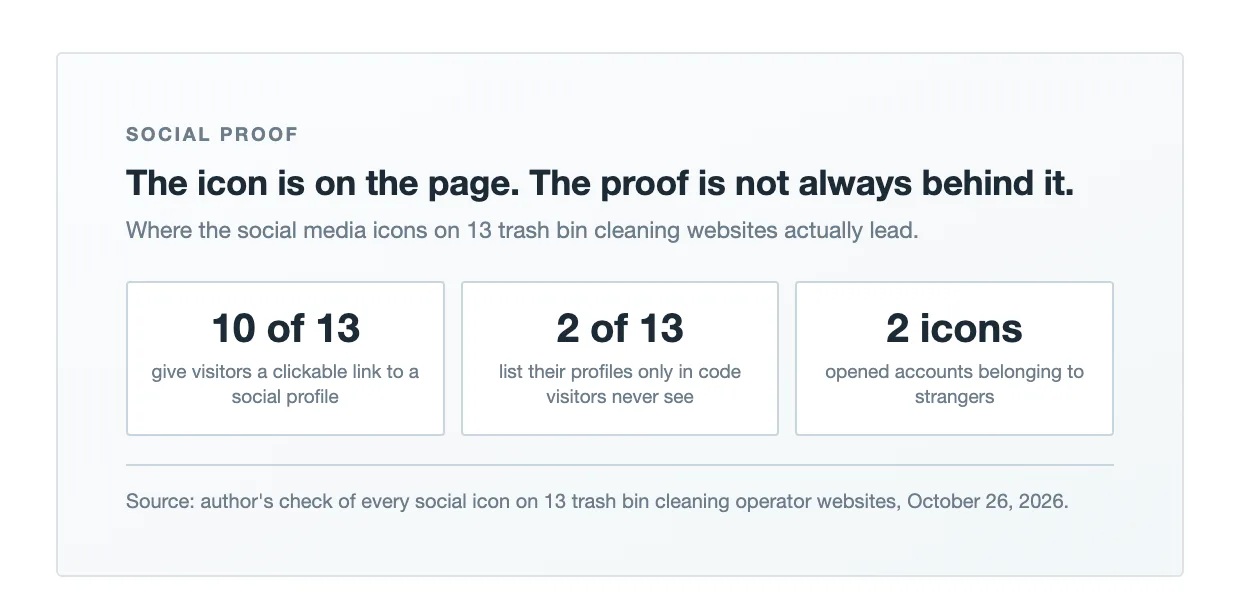
So I went back to 13 operator websites I had reviewed earlier this month, in at least ten states, and on October 26, 2026, I clicked every social media icon on each home page. The question was simple. If a visitor wants that proof, where does the website send them?
Ten of 13 sites give visitors a way to the profile
Ten of the 13 home pages carried at least one clickable link to a social profile. Every one of those ten linked to Facebook. Eight also linked to Instagram.
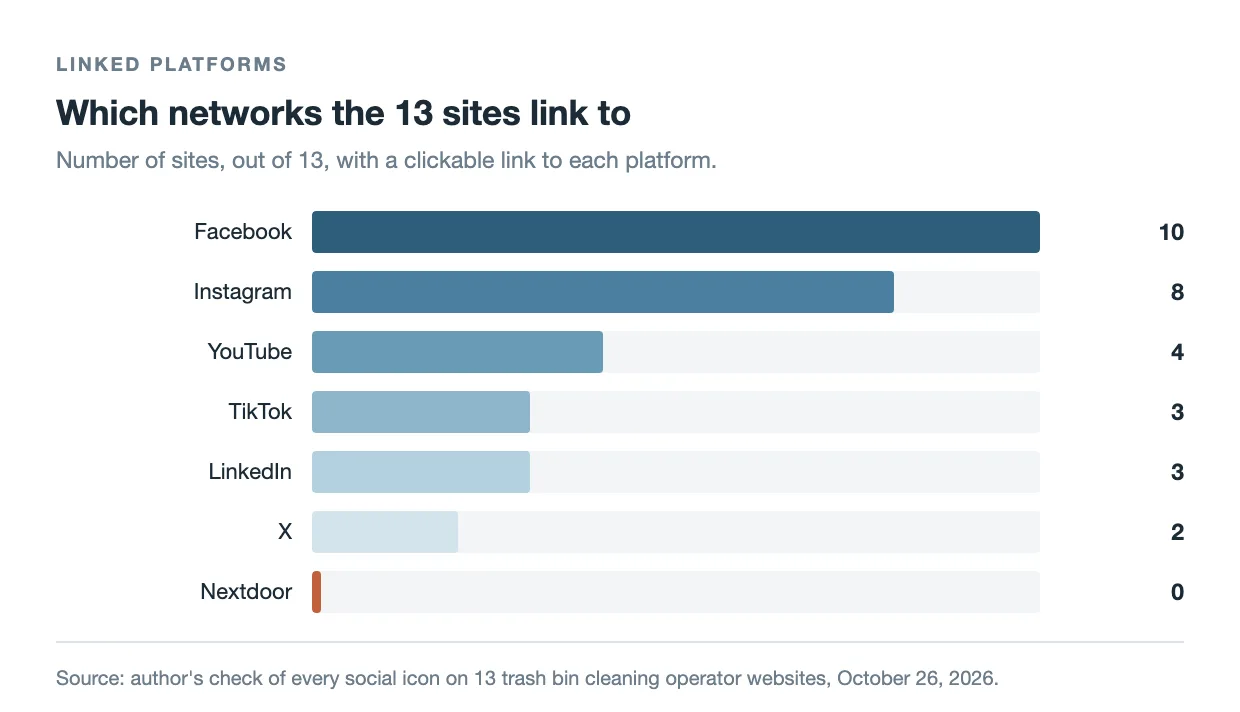
Facebook is universal among the sites that link out. Nobody links to Nextdoor.
Video platforms were far less common. Four sites linked to YouTube, three to TikTok, three to LinkedIn and two to X. None of the 13 linked to Nextdoor, the one network organized entirely around neighborhoods.
That mix tracks with where the audience is. Pew Research Center’s 2026 social media fact sheet puts YouTube use at 84% of U.S. adults and Facebook at 70%, with about half using Instagram. Facebook is the obvious first stop for a business selling to homeowners. YouTube is the largest platform of all, and most of these operators treat it as an afterthought.
Two sites list their profiles where no visitor can see them
The other three sites are more interesting than the totals suggest. Two of them do have social profiles, but the only place those profiles appear is in structured data, the code a site uses to describe itself to search engines.
That markup has a real job. Google’s documentation for organization markup describes the sameAs property as a place to list a business’s profile pages on social media or review sites. It helps a search engine connect the website to the Facebook page. It does nothing for the homeowner reading the page, who sees no icon and no link.
One of those two sites also shows a Facebook Like button, which likes the website page rather than opening the company’s Facebook profile. The third site shows no social profile at all. Its only Facebook code is a tracking pixel, and its customer reviews sit in an embedded widget.
Two icons led to strangers, and one led to the website builder
Clicking through was where the problems showed up. On one site, the YouTube icon opened a Russian-language channel about life and law in the United States. The TikTok icon on the same site opened the personal account of someone with no connection to bin cleaning. Both handles look like guesses typed into a template and never tested.
A second site showed two sets of icons. One set pointed to the company’s real accounts. A second set, in a page section and again in the footer, pointed to the official Facebook, X, LinkedIn and Instagram accounts of the website builder it was made with. A visitor who clicks those lands on a software company’s page and has to find their way back.
Broken social icons were the clearest finding in this check. They cost nothing to fix, and every one of them sends a ready buyer somewhere else at the exact moment they were looking for a reason to trust the business.
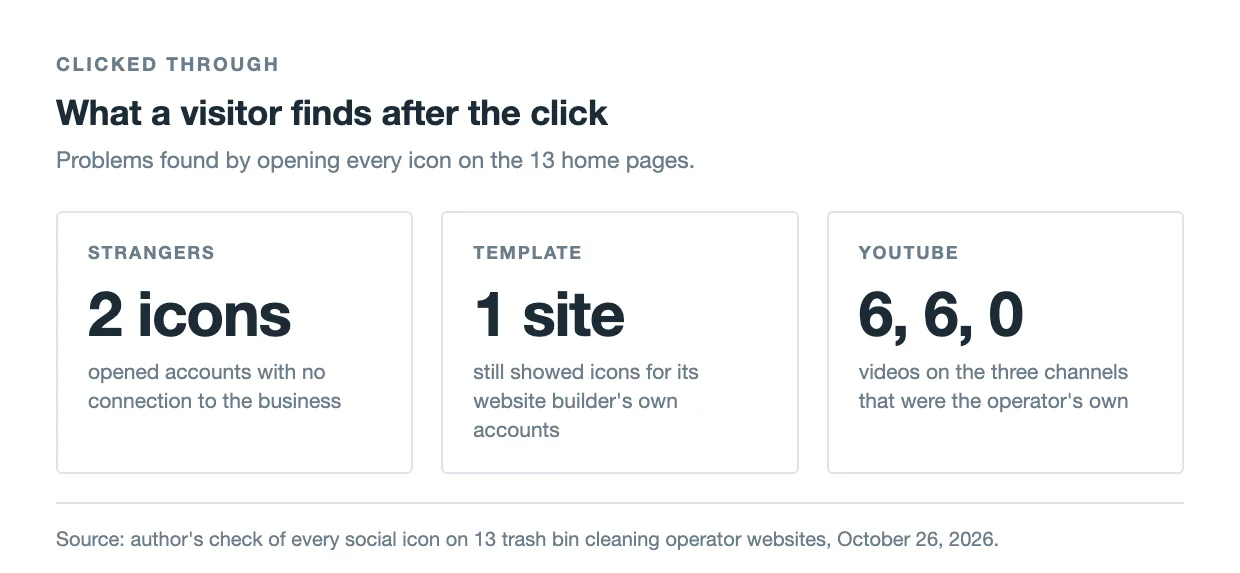
Three problems a visitor only finds by clicking.
The video channels are mostly empty
The three YouTube links that did reach the right company showed how little video these operators publish there. Two channels held six videos each. The third had none.
Only one of the 13 home pages embedded a video at all. For a service whose whole pitch is a before and after, that is a lot of unused footage. Most operators already film their work for Facebook or Instagram. The same clip can go to YouTube Shorts and TikTok with no extra shooting.
What a route business can fix this week
None of this calls for a new website or an agency retainer. It takes one person with a phone and twenty minutes.
Click every social icon on the site, in the header, the footer and any page section, and confirm each one opens the right account. Delete any icon that points to a template account or a handle the business does not own. If profiles only appear in structured data, add visible icons near the footer or the pricing section, where buyers decide.
Then pick the networks the business will actually keep current. A Facebook page with weekly posts beats five empty channels. For bin cleaning, short before and after clips, route day photos and reviews shared from happy customers are the content that shows a stranger the service is real.
Social is the proof step in a subscription sale
A bin cleaning sale is small, recurring and made without anyone from the company present. The website answers price and the signup form takes the card. Social media answers the question in between: is this a real crew that shows up?
When that link is missing, hidden in code or pointed at a stranger, the website asks a homeowner to trust a company they cannot check. For operators who want help building that proof step into the sales process, here is what social media marketing for trash can cleaning companies looks like when the site and the profiles are built to work together.

