
Commercial Buildings of the Same Size Can Need Very Different Cleaning Plans
Federal building data shows how much hours and occupancy differ by building type, which is why square footage alone rarely tells a facility manager what a cleaning plan should include.
When you ask for a commercial cleaning quote, one of the first questions is usually about square footage. It is a reasonable place to begin. Size says something about the job, and it is easy to look up.
It says much less about how a building is actually used. Two facilities of the same size can have very different hours, very different numbers of people inside, and very different ideas of what a clean building means on a Monday morning.
Federal data on commercial buildings makes that difference easy to see.
What the national survey measures
The U.S. Energy Information Administration runs the Commercial Buildings Energy Consumption Survey. Although it is built to study energy use, it also records how commercial buildings are used. Its 2018 summary table estimates about 5.9 million commercial buildings in the United States, with average size, workers, and operating hours for each major building type.
Size itself varies by type. The average office in the survey is about 17,200 square feet, the average religious worship building about 12,500 square feet, and the average education building about 31,100 square feet.
These are national averages from 2018, and no single building will match them. They are useful for comparing building types, not for sizing a specific contract.
Hours change what a building goes through
Operating hours are one of the clearest differences. The average commercial building in the survey operates 62 hours a week, but the figure varies widely by type. Religious worship buildings average 28 hours. Offices average 54, health care buildings 60, mercantile buildings such as stores 64, and food service buildings 81.
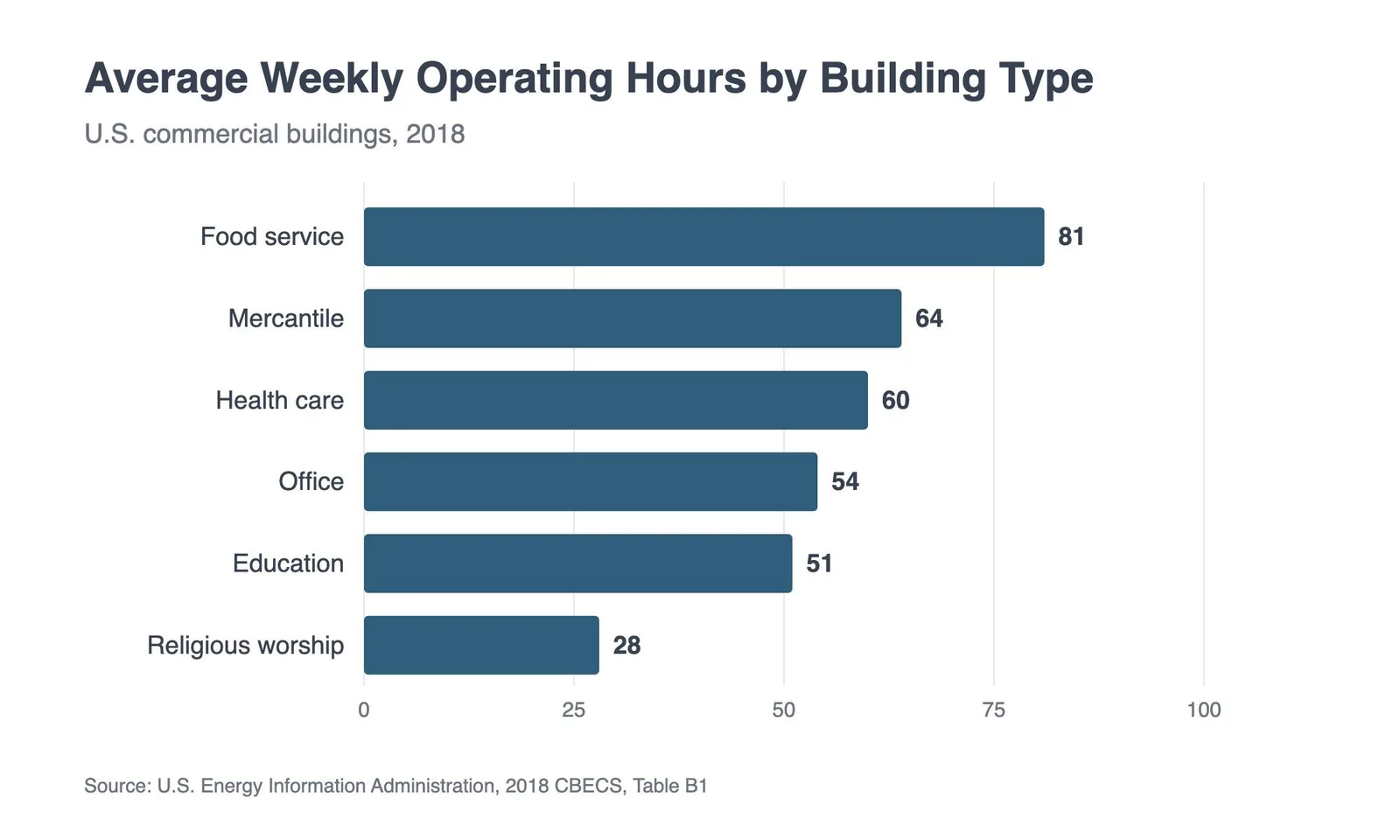
Source: U.S. Energy Information Administration, 2018 Commercial Buildings Energy Consumption Survey, Table B1.
The survey’s table of buildings by activity adds detail. About 324,000 of the country’s 439,000 religious worship buildings, roughly three in four, operate fewer than 40 hours a week. Among offices, about 469,000 of 970,000 fall in the familiar 40 to 48-hour range. Across all building types, about 705,000 buildings are open continuously.
For a facility manager, hours shape practical questions. When is the building empty? Can service happen during the day, or does it need to wait until after hours or the weekend? A building open around the clock raises different scheduling questions than one that is quiet most of the week.
The same space, a different number of people
Occupancy tells a similar story. The survey reports the average floor space per worker in each building type, and the range is wide. Offices average 507 square feet per worker. Religious worship buildings average 2,656 square feet per worker.
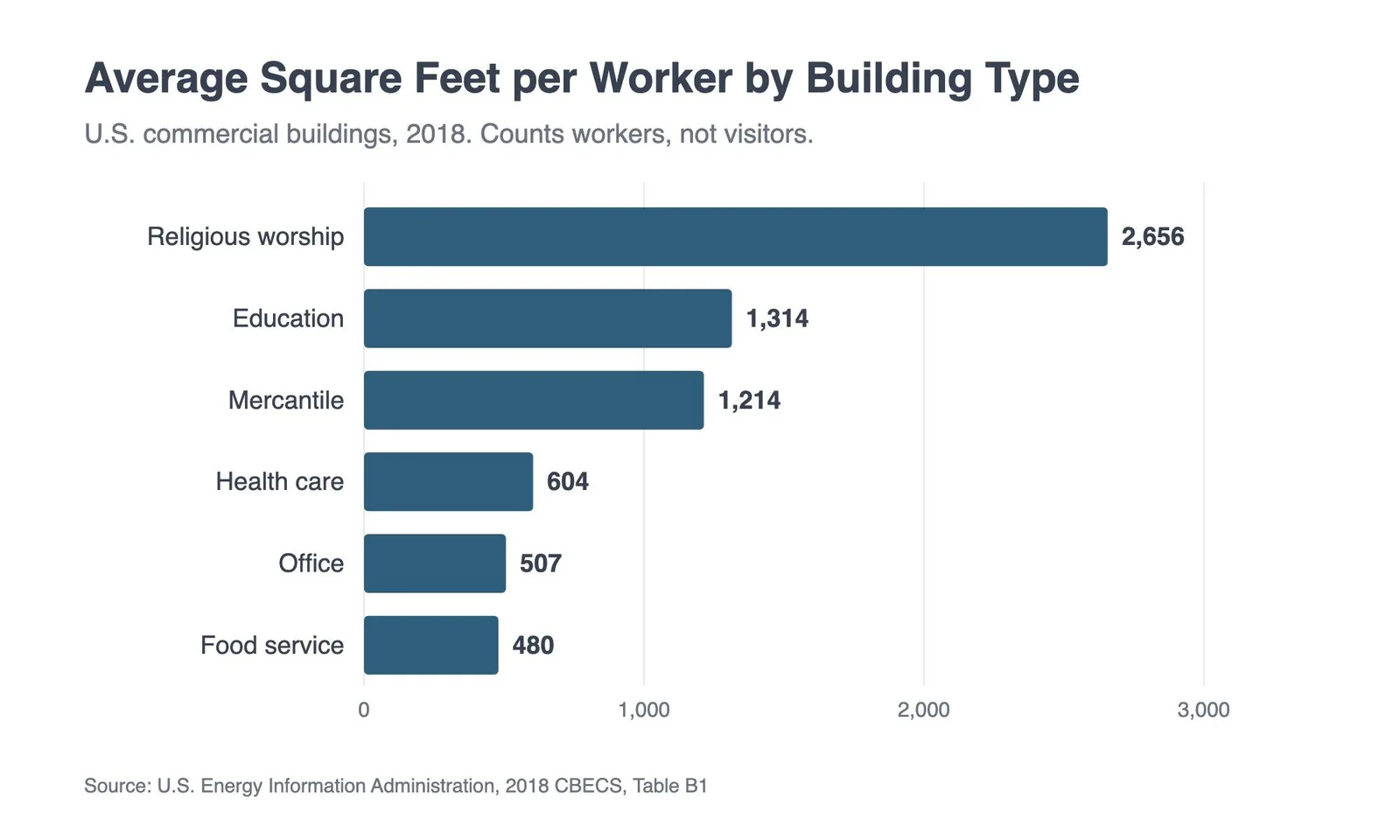
Source: U.S. Energy Information Administration, 2018 Commercial Buildings Energy Consumption Survey, Table B1.
Put those averages on a 10,000-square-foot building, and the difference is easy to picture. An office that size would have about 20 workers. A house of worship that size would have about four.
The comparison has an important limit. These figures count workers, not visitors. A school’s students, a store’s shoppers, and a congregation on Sunday aren’t included, and in many buildings they make up most daily traffic. That gap is a good reason to ask how a facility is used and not to rely on a table.
What facility managers can take from it
None of this means one building type always needs more cleaning than another. It means square footage is one factor among several, and the others are site-specific. Before asking for pricing, it can help to have answers to a few plain questions:
- What are the building’s real hours, including evenings and weekends?
- How many people use it on a typical day, counting visitors as well as staff?
- Which areas see the most use, such as restrooms, entrances, and break rooms?
- What kinds of flooring are in the building?
- When can a cleaning team have access?
- Who provides products and supplies?
Some facilities also have their own requirements. Schools, daycares, and medical offices, for example, may have safety, access, or personnel requirements. Those remain the facility’s responsibility, and it’s best to raise them before service begins so the agreed scope reflects what the cleaning provider is being asked to do. A clear scope helps both sides, because it shows which duties belong to the provider and which stay with the facility.
Why walkthroughs are a common starting point
Those answers are hard to capture in a form, which is one reason many commercial cleaning providers start by seeing the building.
Divine Cleaning and Janitorial, a certified women-owned company serving Baton Rouge and surrounding communities since 2017, is one example. Its website frames the process around that visit: every facility is different, so the company starts with a walkthrough to understand a client’s needs and provide an accurate, customized quote. From there, it develops a customized cleaning plan, service schedule, and clear pricing. Its recurring commercial janitorial services in Baton Rouge are customized to each facility.
A buyer can use the same idea with any provider. A quote is easier to compare when both sides agree on what is included, how often it happens, and who is responsible for what.
A useful number with a short reach
Square footage will stay on every commercial cleaning conversation, and it should. It is simple, and it does describe the size of the job.
Federal data suggests size is only where the conversation starts. The survey shows broad differences between building types, but it cannot describe one facility’s traffic, schedule, or expectations. Those details still have to come from the people who run the building.

