

Baton Rouge Highs Top 90 Degrees From June Through August, NOAA Normals Show
Every restaurant, bar, and convenience store in South Louisiana knows the pattern. The hottest weeks of the year bring the most demand for ice, and that is when the machine seems to fall short.
Usually nothing is broken. An ice machine’s output depends on the air around it and the water coming into it, and a Baton Rouge summer pushes both in the wrong direction.
The Number on the Box Assumes a Mild Room
Commercial ice machines are sold by how many pounds of ice they make in 24 hours. Manufacturers often publish two numbers for the same machine.
The higher figure is measured with 70°F air around the unit and 50°F water. The lower one comes from the industry rating standard, AHRI Standard 810, which tests at 90°F air and 70°F water.
The gap between the two is not small. One published spec sheet for a slim-line cube machine lists 527 pounds a day at 70°F and 50°F, and 450 pounds at 90°F and 70°F, from the same unit.
An owner who sized a machine from the larger number has already given up part of the margin before the first hot day.
That matters most for businesses whose busiest days are also the hottest. A snowball stand, a bar with a patio crowd, or a convenience store selling bagged ice on a July weekend all need the most ice at the moment the machine makes the least.
Baton Rouge Lives at the Rating Point All Summer
The 90°F test condition is not extreme here. It is an ordinary afternoon.
NOAA’s 1991 to 2020 U.S. Climate Normals for Baton Rouge Metropolitan Airport put the normal daily high at 90.5°F in June, 91.9°F in July and 92.2°F in August.
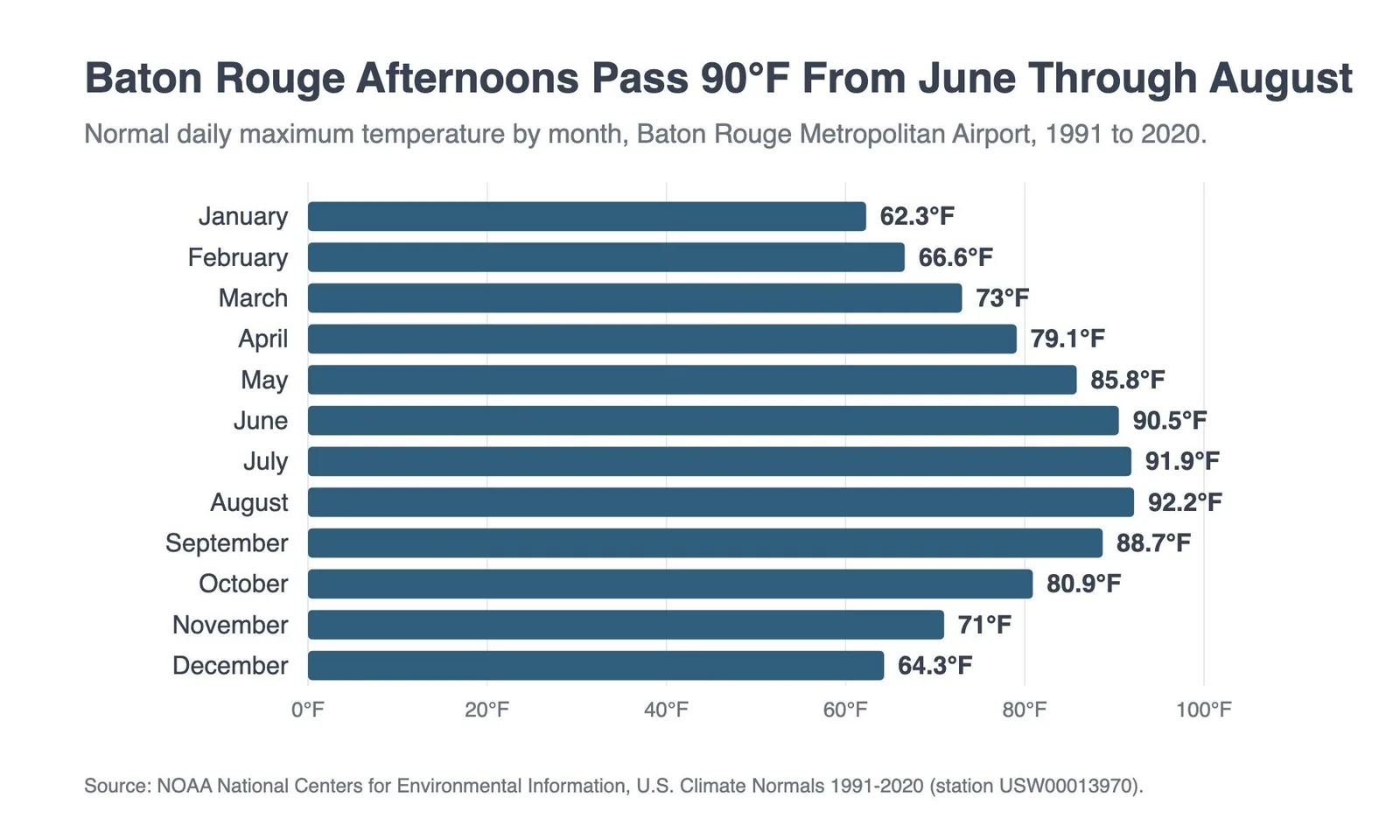
Normal daily high temperature by month in Baton Rouge.
May and September are close behind, at 85.8°F and 88.7°F. That is five months a year when outdoor afternoons sit at or near the temperature the rating standard treats as demanding.
Those are outdoor readings. An ice machine tucked beside a cook line, in a storage room without air conditioning or in a closet with poor airflow can sit in air that is warmer still.
How Much Ice a Hot Room Costs
Manufacturer service documents show the full effect. One self-contained, air-cooled undercounter machine has a published table of 24-hour production across a range of air and water temperatures.
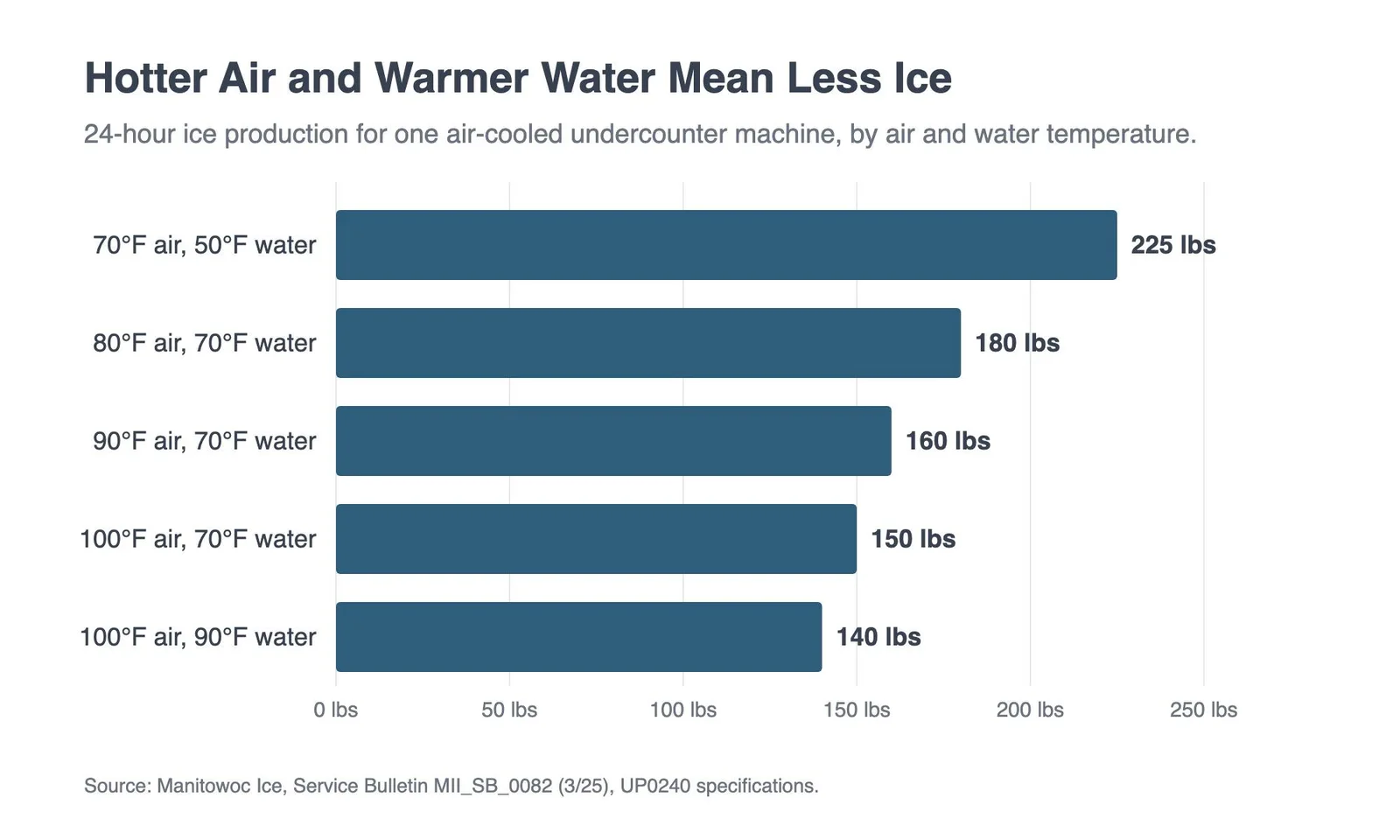
Published daily ice production for one air-cooled undercounter machine at different air and water temperatures.
At 70°F air and 50°F water, that machine is rated for 225 pounds a day. At 90°F air and 70°F water, it drops to 160 pounds. By our arithmetic, that is 65 pounds less, close to 30 percent of the output gone.
Push the air to 100°F, and the water to 90°F, and the table shows 140 pounds. That is more than a third below the best-case number.
The same document lists a maximum operating air temperature of 100°F and a maximum water temperature of 90°F for that model. A machine running past those limits is outside what it was built for.
Why Heat Slows the Machine Down
An ice machine is a small refrigeration system. It pulls heat out of water to freeze it, then has to dump that heat somewhere.
On an air-cooled machine, the heat goes out through a condenser coil and a fan into the room. When the room air is already hot, the coil cannot shed heat as quickly, and each freeze cycle runs longer.
Warmer incoming water adds to the load. Every degree the water arrives above freezing is heat the machine has to remove before ice can form, so longer cycles mean fewer harvests in a day.
The undercounter machine’s service document shows this in minutes. Its freeze time runs about 13.9 to 16.0 minutes at 70°F air and 50°F water, and about 19.5 to 22.5 minutes at 90°F air and 70°F water.
Dirt makes all of it worse. Dust and grease on a condenser coil act like insulation, and a clogged air filter starves the fan of the air it needs.
Ice Is Food, So the Machine Is Food Equipment
Production is only half the concern. The FDA Food Code, the model that state and local regulators use to write their own food safety rules, defines food to include ice.
It also says ice used as food or as a cooling medium must be made from drinking water. Ice bins and the enclosed parts of ice makers must be cleaned at the frequency the manufacturer specifies, or often enough to keep soil and mold from building up.
A warm, damp back room is friendly to that buildup. That makes the cleaning schedule as important in August as the production rate.
A Summer Checklist for Ice Machine Owners
Most of what keeps an ice machine on pace is simple. Nearly all of these steps come straight from the manufacturer documents and the Food Code language above.
- Check the clearance around the cabinet. The two spec sheets reviewed for this article call for 5 to 6 inches at the top, sides, and back.
- Keep the machine away from fryers, ovens, dish machines, and other heat sources where possible.
- Clean the condenser coil and wash any removable air filters on the schedule in the owner’s manual.
- Clean and sanitize the bin and the internal parts at the frequency the manufacturer sets.
- Watch for scale on the evaporator and water parts, and ask about water filtration if it builds up quickly.
- Compare the rated output at 90°F air and 70°F water, not the best-case figure, against what the busiest day actually uses.
When the Machine Still Cannot Keep Up
If a clean, well-ventilated machine still runs short in July, the next step is a closer look at the refrigeration side. A bin that never fills on a mild day points to a problem that cleaning will not solve.
In the Baton Rouge area, Southern Dreams Mechanical is one company that handles commercial ice machine repair in Baton Rouge as part of its commercial refrigeration work. The company says it services, repairs, maintains, and installs walk-in coolers and freezers, chillers, ice machines, reach-ins, and prep equipment for restaurants, convenience stores, and other facilities across South Louisiana.
It covers HVAC as well, which can matter here, since the air conditioning in a kitchen or back room shapes how hard the ice machine has to work. The company says its emergency line is answered around the clock, and that a repair comes with a diagnostic charge and a price before the work starts.
Planning Ice Around the Hottest Month
The pattern behind summer ice shortages is well documented. Ice machines are rated at set air and water temperatures, and Baton Rouge’s normal daily highs from June through August sit above the warmer of those conditions.
That makes planning less about the number on the box and more about a few practical checks: the air around the machine, the water feeding it, the condition of the coil, and the output it can deliver on an August afternoon.

